Beyond EVs: Next-Gen Transportation Innovations for the US

The roar of internal combustion engines is slowly being replaced by the silent hum of electric motors, and charging stations are becoming as common as gas pumps. Electric Vehicles (EVs) have undeniably taken center stage in the ongoing transportation revolution, offering a cleaner, more sustainable alternative to traditional gasoline-powered cars. However, while EVs represent a significant leap forward, they are merely the first act in a much larger, more ambitious transformation of how we move people and goods. The United States, a nation built on innovation and mobility, is poised to embrace a new era of transportation that goes far beyond simply electrifying existing vehicle types.
We are standing on the precipice of a future where daily commutes might involve soaring through the sky, goods could be delivered by self-navigating robots, and inter-city travel could occur at speeds previously relegated to science fiction. This article will delve into the next three disruptive transportation innovations that are set to redefine the landscape of mobility in the US: hyperloop technology, flying cars (specifically Electric Vertical Takeoff and Landing or eVTOL aircraft), and the burgeoning field of autonomous logistics. We will explore their potential, the challenges they face, and how they compare to each other in their quest to shape the future transportation US experience.
The Hyperloop: Blasting Through the US at Near-Supersonic Speeds
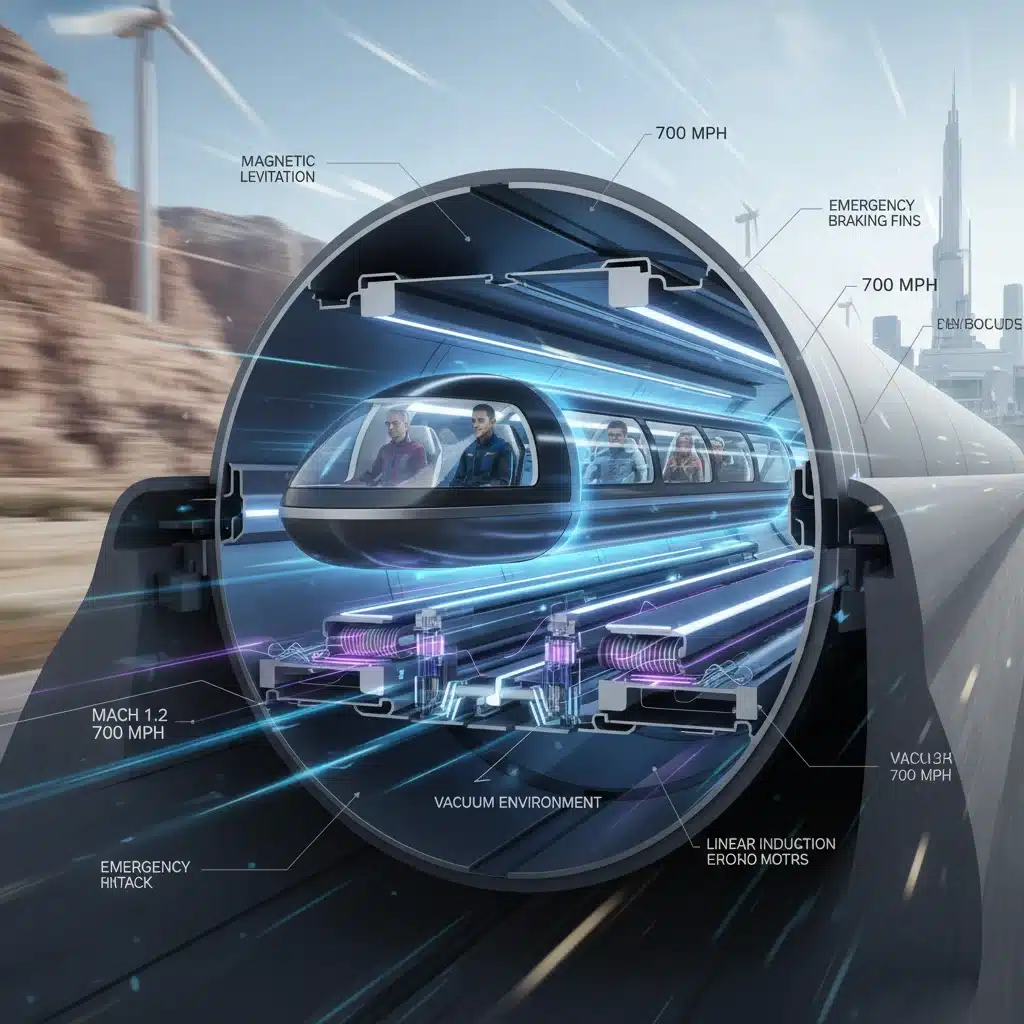
Imagine traveling from Los Angeles to San Francisco in just 30 minutes, or from New York City to Washington D.C. in under half an hour. This isn’t a dream from a futuristic movie; it’s the promise of hyperloop technology. Conceived by Elon Musk and subsequently developed by several companies like Virgin Hyperloop (now HyperloopTT and other independent entities) and Hardt Hyperloop, this concept involves propelling passenger or cargo pods through a near-vacuum tube at incredibly high speeds, potentially exceeding 700 miles per hour (1,126 km/h).
How Hyperloop Works
The core principle behind hyperloop is simple yet revolutionary: eliminate air resistance and friction. This is achieved by creating a low-pressure environment (a near-vacuum) inside sealed tubes. Pods are then levitated using magnetic forces (maglev technology), eliminating friction with the track. Linear electric motors accelerate and decelerate the pods, allowing for astonishing speeds with minimal energy consumption compared to traditional rail or air travel. The enclosed nature of the system also makes it immune to weather conditions, ensuring reliable, on-time operation.
Potential Impact on US Transportation
The implications of hyperloop for future transportation US are monumental. It could fundamentally alter inter-city travel, making long-distance commutes feasible and blurring the lines between major metropolitan areas. This would have profound effects on urban planning, real estate, and economic development. Businesses could expand their talent pools, and people could live further from expensive city centers without sacrificing commute times. Furthermore, hyperloop’s ability to transport cargo quickly and efficiently could revolutionize freight logistics, reducing delivery times and costs.
- Reduced Travel Times: Unprecedented speed for inter-city connections.
- Economic Growth: New opportunities for regional development and business expansion.
- Reduced Congestion: Alleviates pressure on existing road and air infrastructure.
- Environmental Benefits: Potentially a very energy-efficient mode of transport, especially if powered by renewable energy.
Challenges and Roadblocks
Despite its tantalizing potential, hyperloop faces significant hurdles. The primary challenge is the immense cost and complexity of construction. Building thousands of miles of vacuum-sealed tubes, often elevated or underground, requires colossal investment and engineering prowess. Regulatory frameworks and safety standards for such a novel system are also non-existent and need to be developed from scratch. Public acceptance, noise concerns (though contained within tubes, vibration could be an issue), and land acquisition for routes are additional factors that need careful consideration. Securing adequate funding and political will for such a massive infrastructure project in the US remains a formidable task.
Flying Cars (eVTOLs): The Sky’s the Limit for Urban Mobility
For decades, the concept of a ‘flying car’ has been a staple of science fiction, promising a future where personal air travel is commonplace. While the traditional image of a car transforming into an airplane might still be some way off, a more practical and equally revolutionary technology is rapidly emerging: Electric Vertical Takeoff and Landing (eVTOL) aircraft. These vehicles, often resembling large drones or small helicopters, are designed to transport passengers or cargo over short to medium distances, primarily within urban and suburban environments.
The Rise of eVTOLs
Unlike conventional aircraft, eVTOLs do not require runways. Their ability to take off and land vertically makes them ideal for urban air mobility (UAM), utilizing rooftops, parking lots, or designated ‘vertiports.’ Powered by electric motors, they offer a quieter, zero-emission alternative to helicopters and could significantly reduce traffic congestion on the ground. Companies like Joby Aviation, Archer Aviation, and Lilium are at the forefront of developing and testing these aircraft, with some aiming for commercial operations within the next few years, promising to revolutionize future transportation US.
How eVTOLs Will Transform Urban Travel
The introduction of eVTOLs could dramatically alter urban commutes, making previously arduous journeys quick and efficient. Imagine flying from a suburban home to a downtown office in minutes, bypassing gridlock entirely. This could open up new possibilities for living locations, reduce stress associated with commuting, and potentially unlock economic growth in areas currently hampered by poor ground transportation links. Beyond passenger transport, eVTOLs also hold immense potential for emergency services, medical transport, and last-mile delivery of high-value goods, particularly in congested city centers or remote areas.
- Reduced Commute Times: Bypass ground traffic congestion with direct air routes.
- Increased Accessibility: Connects areas difficult to reach by traditional transport.
- Environmental Benefits: Zero direct emissions and quieter operation than helicopters.
- New Economic Opportunities: Creation of new industries for manufacturing, maintenance, and operation of UAM services.
Navigating the Aerial Challenges
The path to widespread eVTOL adoption is fraught with challenges. Air traffic control in urban environments will become significantly more complex, requiring sophisticated new systems and regulations to ensure safety. Noise pollution, even if quieter than helicopters, could still be an issue for residents living near vertiports. Public perception and acceptance are crucial; people need to feel safe and comfortable flying in these new aircraft. Certification by aviation authorities like the FAA is a rigorous and lengthy process, and the infrastructure for vertiports, charging stations, and maintenance facilities needs to be built from the ground up. The cost of travel, at least initially, is also expected to be high, limiting accessibility to a select few.
Autonomous Logistics: The Silent Revolution in Goods Movement
While hyperloop and flying cars capture the imagination with their speed and novelty, autonomous logistics represents a quieter, yet equally transformative force in the future transportation US. This innovation encompasses a wide range of technologies, from self-driving trucks and delivery vans to autonomous drones and robots, all designed to move goods without direct human intervention.
Components of Autonomous Logistics
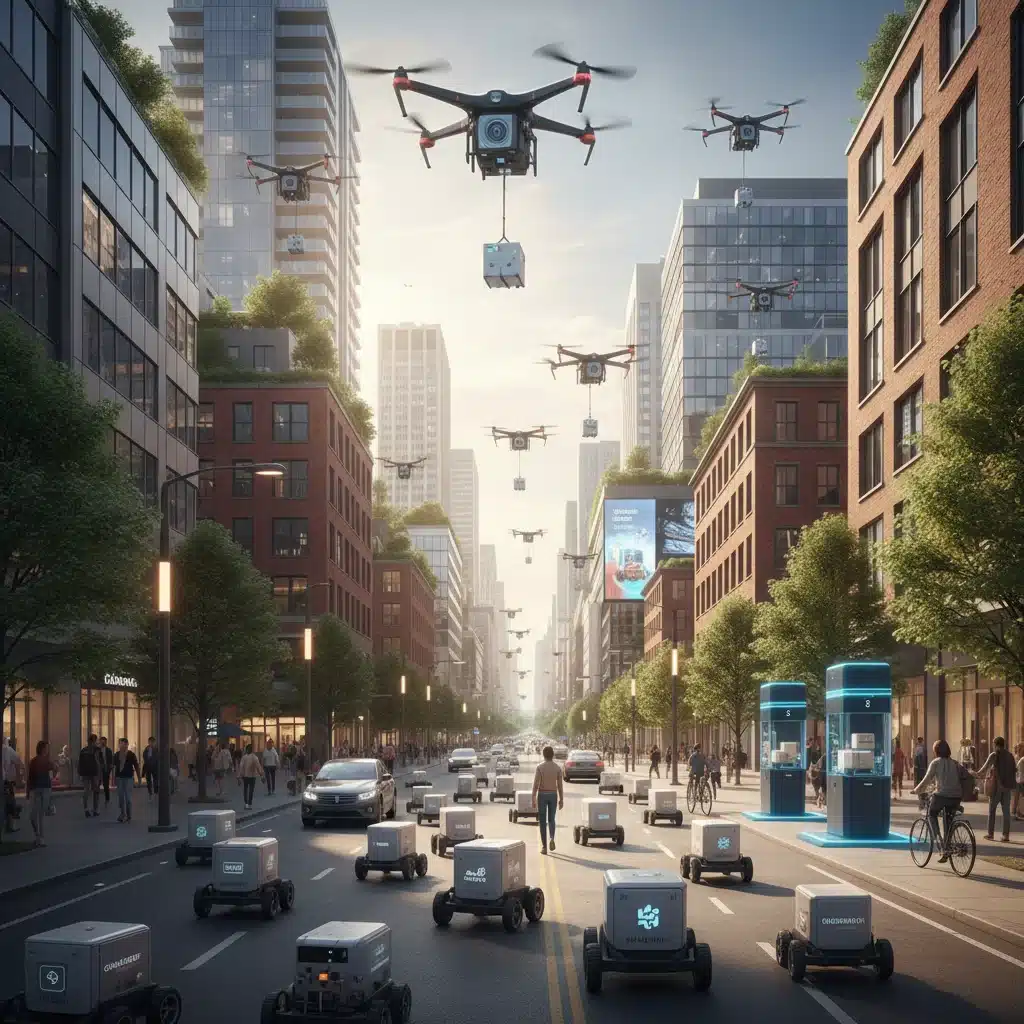
Autonomous logistics is a multi-faceted field. At its core are self-driving vehicles, ranging from heavy-duty trucks traversing highways to smaller vehicles navigating urban streets for last-mile delivery. Drones play a crucial role for aerial delivery, especially for urgent or remote packages. Inside warehouses, autonomous robots are already optimizing inventory management and order fulfillment. The entire system relies heavily on advanced AI, sensor technology, GPS, and robust communication networks to operate efficiently and safely.
Transforming the Supply Chain
The impact of autonomous logistics on the US economy and daily life will be profound. It promises to address critical issues such as driver shortages, reduce operational costs for businesses, and significantly enhance the efficiency and speed of supply chains. Imagine goods moving 24/7 without the need for breaks or sleep, leading to faster delivery times and more reliable schedules. This could particularly benefit e-commerce, making same-day or even hourly delivery a standard expectation. Autonomous farm equipment could optimize agricultural output, and self-driving shuttles could streamline internal corporate campuses or airports.
- Increased Efficiency: 24/7 operation, optimized routes, reduced human error.
- Reduced Costs: Lower labor costs, optimized fuel consumption, fewer accidents.
- Faster Delivery: Enables quicker fulfillment and shorter supply chains.
- Improved Safety: Potential to reduce accidents caused by human fatigue or distraction.
Overcoming the Obstacles
Despite its promise, autonomous logistics faces considerable challenges. Regulatory hurdles are immense, particularly for self-driving trucks and drones operating in public spaces. Questions of liability in the event of accidents, cybersecurity threats to networked systems, and the ethical implications of AI decision-making need comprehensive legal and societal frameworks. Public trust is another major factor; people need to feel confident that autonomous systems are safe and reliable. The displacement of human jobs in trucking and delivery is also a significant socio-economic concern that requires proactive planning and retraining initiatives. Finally, the infrastructure for charging, maintenance, and secure communication for these autonomous fleets needs to be developed and integrated.
Comparison and Synergy: How These Innovations Interact
While each of these innovations – hyperloop, flying cars, and autonomous logistics – offers distinct advantages and addresses different aspects of transportation, their true disruptive power lies in their potential for synergy. They are not isolated technologies but rather pieces of a larger, interconnected future transportation US ecosystem.
- Hyperloop + Autonomous Logistics: Hyperloop could transport autonomous cargo pods between major hubs at high speed, with autonomous trucks or drones handling the first-mile and last-mile delivery to specific destinations. This creates an incredibly efficient, end-to-end supply chain.
- eVTOLs + Autonomous Logistics: eVTOLs could serve as rapid air taxis for people, while also delivering urgent or high-value packages, seamlessly integrating with ground-based autonomous robots for final delivery in complex urban environments.
- All Three Combined: Imagine a scenario where a high-priority package travels via hyperloop across states, is then transferred to an eVTOL for rapid urban air transit, and finally delivered to its precise destination by an autonomous ground robot. This multi-modal, interconnected system represents the pinnacle of future logistics efficiency.
Furthermore, these technologies share common underlying requirements: advanced AI, robust sensor technology, reliable communication networks (like 5G), and the need for significant infrastructure investment. The development in one area often benefits the others, creating a virtuous cycle of innovation.
The Road Ahead: Policy, Investment, and Public Acceptance
Realizing the vision of future transportation US powered by hyperloop, eVTOLs, and autonomous logistics requires more than just technological breakthroughs. It demands a concerted effort from governments, private industry, and the public.
Policy and Regulation
Governments will play a critical role in establishing clear regulatory frameworks that foster innovation while ensuring safety and public welfare. This includes developing new air traffic control systems for eVTOLs, safety standards for hyperloop, and liability laws for autonomous vehicles. Streamlined permitting processes and cross-state cooperation will be essential for large-scale infrastructure projects like hyperloop.
Investment and Infrastructure
The scale of investment required for these technologies is immense. Public-private partnerships will be crucial to fund the research, development, and deployment of new infrastructure, including hyperloop tubes, vertiports, charging networks, and dedicated lanes or zones for autonomous vehicles. The US infrastructure bill is a start, but sustained, long-term commitment will be necessary.
Public Acceptance and Ethical Considerations
Ultimately, the success of these innovations hinges on public acceptance. This requires transparent communication about safety, benefits, and addressing concerns about job displacement, privacy, and the ethical implications of AI-driven systems. Education and pilot programs that demonstrate the reliability and convenience of these new modes of transport will be vital in building trust.
Beyond the Horizon: What Else Could Emerge?
While hyperloop, flying cars, and autonomous logistics are the most prominent next-gen innovations, the future of transportation is bound to hold even more surprises. We might see the development of advanced personal rapid transit (PRT) systems, underground tunnel networks (beyond hyperloop) for urban congestion relief, or even more exotic forms of propulsion. The key drivers will remain the same: the need for speed, efficiency, sustainability, and accessibility in a rapidly growing and urbanizing world. The US, with its pioneering spirit and technological prowess, is uniquely positioned to lead this charge, continually redefining what’s possible in mobility.
Conclusion
Electric vehicles are just the beginning. The future transportation US is poised for a dramatic reshaping, driven by innovations that promise to make our travel faster, cleaner, and more efficient than ever before. Hyperloop offers the promise of ultra-high-speed inter-city connections, eVTOLs are set to revolutionize urban air mobility, and autonomous logistics will silently transform how goods move across the nation. Each technology presents its own set of opportunities and challenges, from immense investment needs and regulatory complexities to public acceptance and ethical considerations.
However, the potential benefits – reduced travel times, decreased congestion, environmental sustainability, and significant economic growth – are too compelling to ignore. As these technologies mature and begin to integrate, they will create a synergistic ecosystem of mobility that will fundamentally alter our daily lives, our cities, and our economy. The journey to this future will require collaboration, foresight, and a continued commitment to innovation, but the destination promises a truly transformative era for transportation in the United States.