The Rise of Explainable AI (XAI): Ensuring Trust in US AI by 2027

In the rapidly evolving landscape of artificial intelligence, the promise of transformative innovation is undeniable. From powering autonomous vehicles to revolutionizing healthcare diagnostics, AI is reshaping every facet of our lives. However, as AI systems become more sophisticated and deeply integrated into critical applications, a pressing question emerges: can we truly trust their decisions? This question lies at the heart of the growing global imperative for Explainable AI (XAI), a field dedicated to making AI systems understandable and transparent. By 2027, the United States is poised to see XAI become not just a desirable feature, but an indispensable cornerstone for ensuring trust and widespread adoption of AI across all sectors.
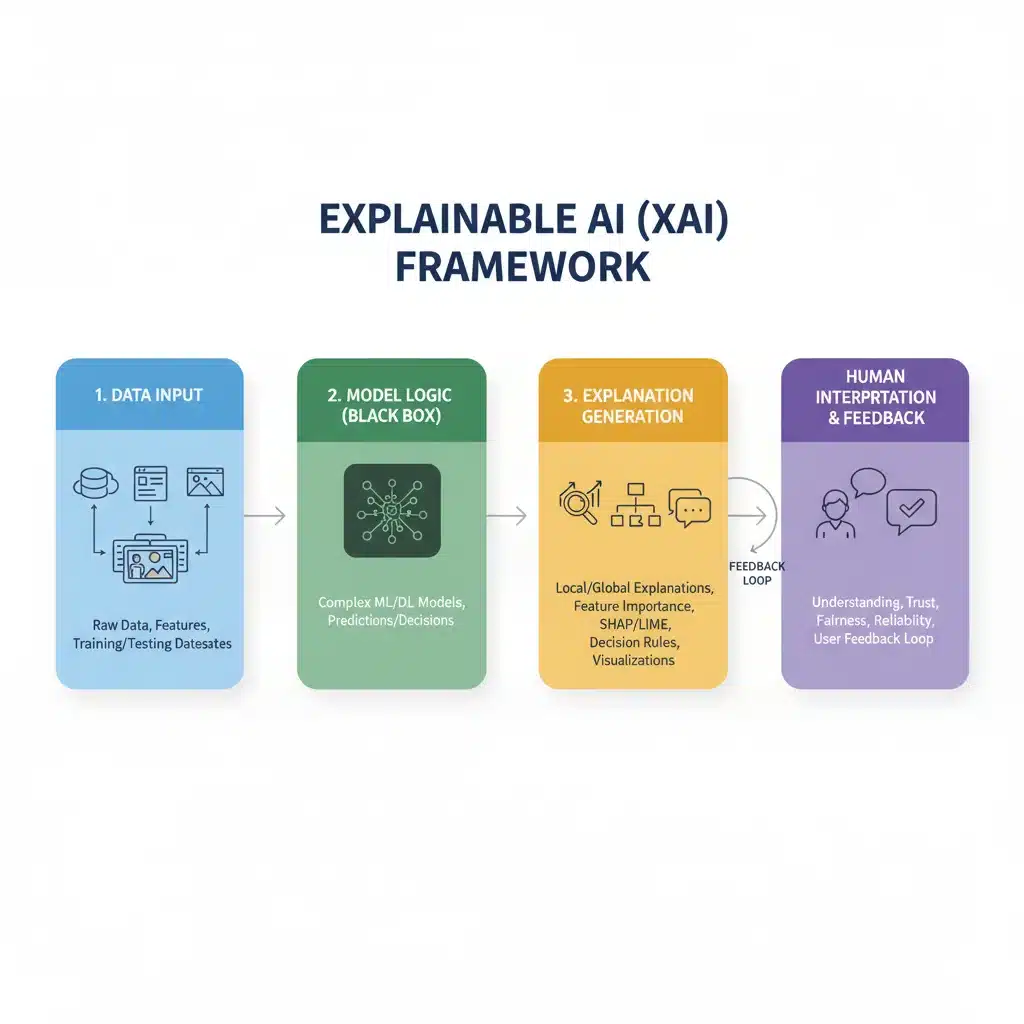
The journey towards robust AI integration is fraught with challenges, primarily stemming from the ‘black box’ nature of many advanced AI models, particularly deep learning algorithms. These models, while achieving remarkable accuracy, often operate in ways that are opaque to human understanding, making it difficult to ascertain why a particular decision was made. This lack of transparency can lead to significant issues, including bias, unfair outcomes, and a general erosion of public confidence. The demand for Explainable AI Trust is thus not merely academic; it is a pragmatic necessity for the responsible deployment and governance of AI.
The ‘Black Box’ Problem and the Imperative for Explainable AI Trust
The term ‘black box’ perfectly encapsulates the challenge of understanding complex AI models. Imagine an AI system that approves or denies loan applications, diagnoses diseases, or even makes recommendations for judicial sentencing. If such a system cannot explain its reasoning, how can we assure fairness, accountability, and ethical operation? This opacity can perpetuate and even amplify existing societal biases embedded in training data, leading to discriminatory outcomes. Furthermore, in regulated industries, the inability to explain an AI’s decision poses significant compliance risks.
The need for Explainable AI Trust becomes even more critical when considering high-stakes applications where errors can have severe consequences. In healthcare, an AI suggesting a treatment plan must be able to justify its recommendation based on patient data and medical knowledge. In autonomous driving, understanding why a vehicle made a particular maneuver is vital for accident investigation and liability assessment. Without explanations, developers, regulators, and end-users are left in the dark, unable to scrutinize, validate, or improve these systems effectively.
The push for XAI is therefore a direct response to these challenges, aiming to transform opaque AI systems into transparent, interpretable ones. This involves developing techniques that allow humans to comprehend the outputs of AI models without compromising their accuracy or performance. The ultimate goal is to foster a sense of reliability and confidence, ensuring that AI serves humanity responsibly and ethically.
Key Pillars of Explainable AI (XAI)
XAI is not a single technology but a collection of techniques and methodologies designed to achieve interpretability. These pillars collectively contribute to building Explainable AI Trust:
- Interpretability: The degree to which a human can understand the cause of a decision. This can range from simple models like linear regressions, which are inherently interpretable, to complex neural networks that require post-hoc explanation techniques.
- Transparency: The ability to understand how the AI model works internally. This includes understanding the algorithms, parameters, and data transformations applied.
- Audibility: The capacity to trace an AI’s decision-making process back to its input data and model logic, allowing for verification and validation.
- Fairness: Ensuring that AI decisions are unbiased and do not discriminate against certain groups. XAI helps in identifying and mitigating biases by exposing the features that influence decisions.
- Privacy: While explaining decisions, XAI must also adhere to privacy principles, especially when dealing with sensitive personal data.
These pillars collectively support the development of robust and trustworthy AI systems. By focusing on these aspects, organizations can move beyond simply deploying AI to deploying AI responsibly and effectively.
The US Regulatory Landscape and XAI by 2027
The United States is actively grappling with how to regulate AI, recognizing both its potential and its risks. By 2027, it is highly probable that XAI will be a central component of US AI regulatory frameworks. Several initiatives and proposals already highlight this trend:
- National AI Initiative Act of 2020: This act calls for research into trustworthy AI, including interpretability and explainability. It underscores the government’s commitment to developing AI that is not only powerful but also transparent and accountable.
- NIST AI Risk Management Framework (RMF): The National Institute of Standards and Technology (NIST) has developed a framework to help organizations manage the risks associated with AI. Explainability is a key component of this framework, emphasizing the need for understanding AI system behavior.
- Proposed State-Level Regulations: Various states are exploring their own AI regulations, particularly in areas like employment, credit, and insurance, where AI decisions can have significant impact on individuals. Many of these proposals include provisions for explainability and fairness.
- Executive Orders and White House Directives: The Biden administration has issued executive orders emphasizing responsible AI innovation, highlighting the need for AI systems that are transparent, equitable, and accountable.
These regulatory developments are not just about compliance; they are about fostering an environment where AI can flourish responsibly. Companies that proactively integrate XAI into their AI development pipelines will be better positioned to meet future regulatory demands and gain a competitive edge by demonstrating their commitment to ethical AI. The ability to demonstrate Explainable AI Trust will become a non-negotiable requirement for operating in key sectors.
Ethical Considerations and Societal Impact
The ethical implications of AI are vast and complex. Without XAI, addressing issues like algorithmic bias, fairness, and accountability becomes incredibly challenging. For instance, if an AI system used in criminal justice consistently recommends harsher sentences for certain demographic groups, without explainability, it would be nearly impossible to identify the source of this bias and rectify it. XAI provides the tools necessary to uncover and mitigate such ethical pitfalls.
Moreover, public acceptance and trust in AI are heavily dependent on its perceived fairness and transparency. If people do not understand how AI makes decisions, they are less likely to trust it, leading to resistance in adoption and potential societal backlash. XAI helps demystify AI, making it more accessible and understandable to a broader audience, thereby fostering greater public confidence. By 2027, the societal demand for ethical AI will be a dominant force, making Explainable AI Trust a critical factor in public discourse and policy.
The integration of XAI also empowers human oversight. Instead of blindly accepting AI decisions, human operators can review explanations, challenge questionable outputs, and intervene when necessary. This human-in-the-loop approach is crucial for maintaining control and ensuring that AI systems augment, rather than replace, human judgment, particularly in sensitive domains.
Technical Approaches to Achieving XAI
Developing XAI involves a diverse set of technical approaches, broadly categorized into two main types:
- Ante-hoc Explainability: This approach focuses on designing AI models that are inherently interpretable from the ground up. Examples include decision trees, rule-based systems, and certain types of generalized additive models. While these models might not always achieve the same level of predictive power as complex ‘black box’ models, their transparency is a core feature.
- Post-hoc Explainability: This involves applying techniques to existing, already trained ‘black box’ models to generate explanations for their decisions. These techniques can be model-agnostic (working with any AI model) or model-specific.
Popular Post-hoc XAI Techniques:
- LIME (Local Interpretable Model-agnostic Explanations): LIME explains the predictions of any classifier or regressor by approximating it locally with an interpretable model. It highlights which features in the input data are most relevant to a specific prediction.
- SHAP (SHapley Additive exPlanations): Based on cooperative game theory, SHAP attributes the contribution of each feature to the model’s output. It provides a unified measure of feature importance, applicable to various models.
- Feature Importance: Many models, like tree-based algorithms, can inherently provide a measure of how important each feature was in making a prediction.
- Partial Dependence Plots (PDPs) and Individual Conditional Expectation (ICE) Plots: These visualize the marginal effect of one or two features on the predicted outcome of a machine learning model.
- Counterfactual Explanations: These explanations describe the smallest change to the input data that would alter the model’s prediction to a desired outcome. For example, ‘If you had a credit score of X instead of Y, your loan would have been approved.’
The choice of XAI technique depends on the specific application, the type of AI model, and the target audience for the explanation. By 2027, these techniques will be more refined, standardized, and integrated into mainstream AI development tools, making it easier for developers to build Explainable AI Trust into their systems.
Industry Adoption and Use Cases by 2027
The demand for XAI is not confined to regulatory bodies or academic research; industries across the board are recognizing its practical value. By 2027, we anticipate widespread adoption of XAI in various sectors within the US:
Healthcare:
In healthcare, AI assists with diagnostics, drug discovery, and personalized treatment plans. XAI is crucial for:
- Clinical Decision Support: Explaining why an AI recommends a particular diagnosis or treatment plan helps clinicians understand, validate, and trust the recommendation, leading to better patient outcomes.
- Drug Discovery: Understanding which molecular features an AI considers important for a drug’s efficacy can guide researchers in developing new compounds.
- Patient Monitoring: Explaining anomalies detected by AI in patient data can alert medical staff to potential critical conditions.
Finance and Banking:
AI is heavily used in fraud detection, credit scoring, and algorithmic trading. XAI addresses critical needs here:
- Credit Scoring: Explaining why a loan application was denied is not only a regulatory requirement (e.g., Fair Credit Reporting Act) but also helps applicants understand how to improve their creditworthiness.
- Fraud Detection: Understanding why a transaction was flagged as fraudulent helps investigators identify new fraud patterns and refine detection systems.
- Regulatory Compliance: Demonstrating explainability is vital for compliance with financial regulations and auditing requirements.
Autonomous Systems:
From self-driving cars to robotic manufacturing, understanding AI decisions is paramount for safety and liability:
- Self-Driving Cars: In the event of an incident, XAI can explain why an autonomous vehicle took a certain action, providing crucial insights for accident reconstruction and liability assessment.
- Robotics: Explaining robotic errors helps engineers diagnose problems and improve system reliability.
Legal and Justice:
AI is beginning to be used in legal research and predictive policing. XAI is essential for:
- Predictive Policing: Explaining why an AI predicts a higher crime rate in a certain area can help ensure that biases are not inadvertently introduced or amplified.
- Legal Document Review: Understanding why an AI highlights certain clauses in a contract can expedite legal processes and ensure accuracy.
Defense and National Security:
In critical defense applications, where AI assists in decision-making, understanding its rationale is crucial for trust and accountability.
These diverse applications underscore that by 2027, Explainable AI Trust will be a competitive differentiator and a fundamental requirement for any organization leveraging AI in sensitive or regulated domains.

Challenges and Future Directions for XAI
Despite the rapid advancements, the path to universal XAI adoption is not without its challenges:
- Trade-off Between Explainability and Accuracy: Often, the most accurate AI models are the least interpretable. Finding the right balance between these two can be a significant challenge for developers.
- Scalability and Computational Cost: Generating explanations for complex models can be computationally intensive, especially for real-time applications.
- Human-Centric Explanations: The goal of XAI is to provide explanations that humans can understand. This requires interdisciplinary research involving cognitive science and human-computer interaction to design effective explanations.
- Standardization: There is currently no universal standard for what constitutes a ‘good’ explanation, making it difficult to compare and evaluate different XAI techniques.
- Data Privacy in Explanations: Explanations themselves can sometimes inadvertently reveal sensitive information from the training data, posing new privacy challenges.
Addressing these challenges will be crucial for the continued growth and maturity of XAI. Future research will likely focus on developing more efficient, robust, and human-understandable explanation techniques, as well as integrating XAI seamlessly into the entire AI lifecycle, from data preparation to deployment and monitoring.
By 2027, we can expect to see advancements in:
- Automated XAI Tools: Integrated development environments (IDEs) and MLOps platforms will likely offer built-in XAI capabilities, making it easier for developers to implement explainability.
- Interactive Explanations: Users will be able to interact with AI explanations, asking ‘what-if’ questions and exploring different scenarios to gain deeper insights.
- Domain-Specific XAI: Tailored XAI solutions will emerge for specific industries, addressing unique regulatory and ethical requirements.
- Explainability as a Service (XaaS): Cloud providers may offer XAI capabilities as a service, lowering the barrier to entry for organizations seeking to implement explainable AI.
These developments will further solidify the foundation for Explainable AI Trust across the US AI ecosystem.
The Competitive Advantage of Explainable AI Trust
Beyond regulatory compliance and ethical considerations, embracing XAI offers a significant competitive advantage. Companies that can demonstrate explainable and trustworthy AI systems will differentiate themselves in the market. This trust will translate into:
- Increased Customer Loyalty: Customers are more likely to engage with and rely on products and services powered by AI they can understand and trust.
- Enhanced Brand Reputation: Organizations known for their commitment to ethical and transparent AI will build a stronger brand image.
- Improved AI Model Development: XAI helps developers debug models, identify biases, and understand model limitations, leading to more robust and accurate AI systems.
- Faster Adoption in Regulated Industries: Companies with built-in XAI will face fewer hurdles in deploying AI in highly regulated sectors like finance and healthcare.
- Better Risk Management: Understanding AI decisions allows organizations to better assess and mitigate operational, reputational, and legal risks associated with AI deployment.
By 2027, the market will increasingly reward organizations that prioritize Explainable AI Trust, making it a strategic imperative rather than just a technical add-on.
Conclusion: The Inevitable Rise of Explainable AI Trust by 2027
The trajectory for AI in the United States is clear: it will become more pervasive, more powerful, and consequently, more scrutinized. The ‘black box’ era of AI is rapidly drawing to a close, replaced by an urgent demand for transparency and accountability. By 2027, Explainable AI (XAI) will transition from an emerging concept to a fundamental requirement, deeply embedded in the design, deployment, and governance of AI systems across all critical sectors.
The confluence of evolving regulatory frameworks, heightened ethical awareness, increasing public demand for transparency, and practical industry needs is driving this transformation. Companies that proactively invest in XAI technologies and methodologies will not only comply with future mandates but will also gain a formidable competitive edge, fostering deeper customer loyalty, strengthening brand reputation, and developing more robust and reliable AI solutions. The ability to articulate ‘why’ an AI made a particular decision will be as crucial as the decision itself.
Ultimately, the rise of Explainable AI Trust is about ensuring that as AI continues to reshape our world, it does so in a manner that is fair, ethical, safe, and ultimately, beneficial for all. The future of AI in the US is not just intelligent; it is intelligently transparent, and that transparency is built on the bedrock of XAI.