
Edge Computing 2026: A Comparison of 3 Leading Platforms for US Businesses Seeking Real-time Data Processing
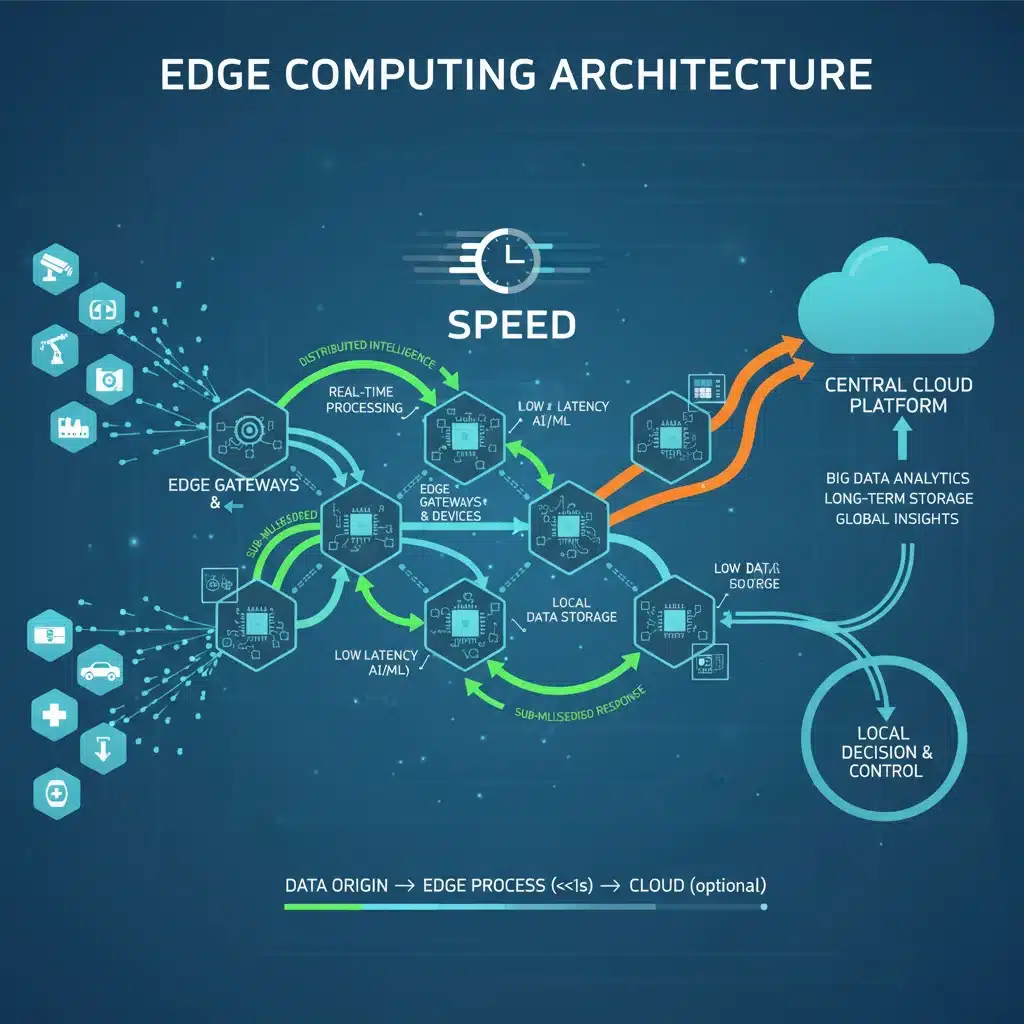
The digital landscape is evolving at an unprecedented pace, and at its forefront is the relentless demand for real-time data processing. For US businesses, staying competitive means not just collecting data, but extracting immediate, actionable insights from it. This is where Edge Computing Platforms become indispensable. By bringing computation and data storage closer to the sources of data, edge computing minimizes latency, conserves bandwidth, and enables near-instantaneous decision-making. As we look towards 2026, the adoption of edge computing is set to accelerate dramatically, transforming industries from manufacturing and retail to healthcare and logistics.
The promise of edge computing lies in its ability to unlock new efficiencies, enhance customer experiences, and foster innovation. Imagine autonomous vehicles processing sensor data in milliseconds to avoid collisions, smart factories optimizing production lines in real-time, or healthcare providers monitoring patients remotely with immediate alerts. These scenarios, once futuristic, are becoming today’s reality thanks to robust Edge Computing Platforms. However, navigating the myriad of available solutions can be a daunting task for businesses. Each platform offers unique strengths, catering to different operational scales, industry needs, and technical requirements.
In this comprehensive guide, we will delve into the world of edge computing, focusing on the three leading platforms projected to dominate the US market by 2026. Our aim is to provide US businesses with a clear, in-depth comparison, highlighting their core features, benefits, potential use cases, and what sets them apart. By understanding these distinctions, organizations can make informed decisions, selecting the Edge Computing Platforms that best align with their strategic objectives and operational demands for real-time data processing.
Understanding the Imperative of Edge Computing for US Businesses
Before we dissect the leading platforms, it’s crucial to grasp why edge computing has become a critical technological imperative for US businesses. The proliferation of IoT devices, coupled with the exponential growth of data generated at the periphery of networks, has created a bottleneck for traditional cloud-centric architectures. Relying solely on centralized cloud data centers for processing every byte of information is no longer sustainable or efficient, especially for applications demanding ultra-low latency.
Real-time data processing is not just a buzzword; it’s a fundamental requirement for many modern business operations. In sectors like manufacturing, predictive maintenance relies on immediate analysis of sensor data to prevent costly downtime. In retail, real-time inventory management and personalized customer experiences are powered by edge analytics. For smart cities, instantaneous traffic management and public safety responses depend on data processed at the edge. The ability to act on data within milliseconds can mean the difference between a minor incident and a major crisis, or a lost opportunity and a significant competitive advantage.
Furthermore, edge computing addresses concerns related to data privacy and regulatory compliance. By processing sensitive data locally, businesses can reduce the need to transmit all data to the cloud, thereby enhancing security and simplifying adherence to regulations like HIPAA or GDPR (even for US businesses handling international data). This localized processing also contributes to significant cost savings on bandwidth and cloud egress fees, making it an economically attractive solution in the long run.
The strategic deployment of Edge Computing Platforms allows US businesses to:
- Minimize Latency: Crucial for mission-critical applications where delays are unacceptable.
- Improve Bandwidth Efficiency: Only relevant data is sent to the cloud, reducing network strain and costs.
- Enhance Data Security and Privacy: Processing data closer to its source reduces exposure during transit.
- Increase Operational Resilience: Edge devices can operate autonomously even with intermittent cloud connectivity.
- Enable New Business Models: Facilitates innovative services and applications that require immediate insights.
As the digital transformation journey continues, the strategic adoption of robust Edge Computing Platforms will be a defining factor in the success and resilience of US businesses in 2026 and beyond.
Criteria for Evaluating Leading Edge Computing Platforms
Selecting the right Edge Computing Platforms is a complex decision that requires careful consideration of various factors. For US businesses, the ideal platform will not only meet current operational needs but also offer scalability and flexibility for future growth. Our evaluation of the top three platforms for 2026 is based on several key criteria:
- Performance and Latency: The ability to deliver ultra-low latency for real-time applications.
- Scalability and Flexibility: How easily the platform can scale up or down, and adapt to diverse workloads.
- Security Features: Robust mechanisms for data protection, access control, and threat detection at the edge.
- Ecosystem and Integration: Compatibility with existing infrastructure, IoT devices, cloud services, and developer tools.
- Management and Orchestration: Ease of deployment, monitoring, and management of edge devices and applications from a centralized control plane.
- Cost-Effectiveness: Total cost of ownership, including hardware, software, bandwidth, and operational expenses.
- Industry-Specific Solutions: The platform’s ability to cater to particular industry requirements and use cases.
- Developer Experience: Tools, APIs, and documentation available for developers to build and deploy edge applications.
These criteria provide a holistic framework for assessing the true value and long-term viability of each of the Edge Computing Platforms we will discuss. Businesses must weigh these factors against their specific needs, existing IT infrastructure, and strategic goals to make an informed choice.
Platform 1: AWS IoT Greengrass – The Cloud-to-Edge Continuum
Amazon Web Services (AWS) has long been a dominant force in cloud computing, and its offering in the edge space, AWS IoT Greengrass, leverages this extensive ecosystem. AWS IoT Greengrass extends AWS cloud capabilities to edge devices, allowing them to perform local compute, messaging, data caching, sync, and ML inference capabilities. For US businesses already heavily invested in the AWS cloud, Greengrass offers a seamless and powerful extension of their existing infrastructure, making it one of the most compelling Edge Computing Platforms.
Key Features and Benefits:
- Seamless Cloud Integration: Tightly integrated with AWS IoT Core, Lambda, S3, and other AWS services, enabling a consistent development and deployment experience from cloud to edge.
- Local Compute and ML Inference: Run AWS Lambda functions and deploy machine learning models directly on edge devices, allowing for real-time data processing and decision-making without constant cloud connectivity.
- Local Device Communication: Enables secure communication between devices on a local network, even without internet access, fostering device-to-device interaction and local data aggregation.
- Data Sync and Caching: Intelligently syncs data between edge devices and the AWS cloud, ensuring data consistency and providing local data caching for offline operations.
- Over-the-Air (OTA) Updates: Facilitates secure remote updates for software, configurations, and machine learning models on edge devices, simplifying maintenance and ensuring up-to-date functionality.
- Robust Security: Built-in security features, including authentication, authorization, and encryption, protect data and devices at the edge.
Ideal Use Cases for US Businesses:
- Industrial IoT (IIoT): Real-time monitoring and control of factory equipment, predictive maintenance, and quality control in manufacturing plants.
- Smart Retail: In-store analytics, personalized customer experiences, inventory management, and smart shelving systems.
- Connected Vehicles: Local processing of sensor data for autonomous driving functions and fleet management.
- Healthcare: Remote patient monitoring, real-time analysis of medical device data, and local processing of sensitive patient information.
The strength of AWS IoT Greengrass lies in its deep integration with the broader AWS ecosystem, making it an attractive option for businesses looking for a unified cloud-to-edge strategy. Its ability to run serverless functions and ML models locally positions it as a leader among Edge Computing Platforms for organizations prioritizing agility and advanced analytics at the edge.
Platform 2: Microsoft Azure IoT Edge – Bridging Cloud and On-Premise
Microsoft Azure IoT Edge extends Azure cloud intelligence to edge devices, much like Greengrass does for AWS. However, Azure IoT Edge distinguishes itself with its strong focus on hybrid cloud environments and its ability to integrate seamlessly with existing Microsoft enterprise solutions. For US businesses with significant investments in Microsoft technologies, Azure IoT Edge provides a familiar and robust pathway to leveraging Edge Computing Platforms.
Key Features and Benefits:
- Containerized Workloads: Supports deploying and managing containerized modules (Docker compatible) on edge devices, allowing for flexibility in application development and deployment using various languages and runtimes.
- Offline Capabilities: Modules can run autonomously offline, storing data locally and syncing with Azure IoT Hub when connectivity is restored, ensuring continuous operation.
- AI and Machine Learning at the Edge: Enables deployment of custom AI/ML models trained in Azure Machine Learning directly to edge devices for real-time inference and intelligent decision-making.
- Security and Device Management: Comprehensive security features, including hardware-backed security (TPM), secure boot, and remote device management capabilities through Azure IoT Hub.
- Integration with Azure Services: Deep integration with Azure IoT Hub, Azure Stream Analytics, Azure Functions, and other Azure services, providing a powerful end-to-end solution.
- Open Source Components: Leverages open-source components, offering transparency and flexibility for developers.
Ideal Use Cases for US Businesses:
- Smart Buildings: Energy management, security systems, and environmental control with local data processing.
- Logistics and Supply Chain: Asset tracking, cold chain monitoring, and predictive maintenance for logistics equipment.
- Oil & Gas: Remote monitoring of pipelines and drilling equipment, anomaly detection, and operational optimization in harsh environments.
- Retail Analytics: Customer behavior analysis, inventory optimization, and loss prevention using local video analytics.
Azure IoT Edge’s strength lies in its container-based approach, offering significant flexibility for developers and its strong ties to the Azure ecosystem, making it a natural choice for enterprises already using Microsoft products. Its robust security and management features position it as a top contender among Edge Computing Platforms for businesses requiring hybrid cloud solutions and enterprise-grade reliability.
Platform 3: Google Cloud IoT Edge – AI-Powered Edge Intelligence
Google Cloud, renowned for its prowess in AI and machine learning, extends these capabilities to the edge with Google Cloud IoT Edge. This platform focuses on bringing Google’s advanced analytics and AI models directly to edge devices, enabling intelligent operations closer to the data source. For US businesses prioritizing AI-driven insights and leveraging Google Cloud’s powerful data analytics tools, Google Cloud IoT Edge stands out among Edge Computing Platforms.
Key Features and Benefits:
- AI/ML at the Edge with TensorFlow Lite: Easily deploy machine learning models optimized for edge devices using TensorFlow Lite, enabling real-time inference for computer vision, natural language processing, and other AI applications.
- Edge-to-Cloud Data Management: Securely connects edge devices to Google Cloud IoT Core for robust device management, data ingestion, and integration with other Google Cloud services like BigQuery and Cloud Pub/Sub.
- Managed Service for Edge Devices: Simplifies the deployment and management of edge devices and applications, reducing operational overhead.
- Open and Flexible Architecture: Supports a wide range of devices and operating systems, offering flexibility for various edge deployments.
- Advanced Analytics Integration: Seamlessly integrates with Google Cloud’s powerful data analytics and visualization tools, allowing for comprehensive insights from edge-generated data.
- Security by Design: Incorporates Google’s robust security infrastructure from the cloud down to the edge device.
Ideal Use Cases for US Businesses:
- Vision AI in Retail/Manufacturing: Real-time defect detection, quality control, security monitoring, and customer flow analysis using cameras at the edge.
- Predictive Maintenance with AI: Deploying machine learning models on industrial equipment to predict failures before they occur.
- Smart Agriculture: AI-powered analysis of crop health, soil conditions, and livestock monitoring at the farm edge.
- Robotics and Automation: Enabling autonomous robots to make real-time decisions based on local sensor data and AI models.
Google Cloud IoT Edge’s distinct advantage lies in its strong emphasis on AI and machine learning capabilities at the edge. For businesses looking to embed intelligence directly into their operations and capitalize on Google’s leading AI technologies, this platform offers a compelling solution within the competitive landscape of Edge Computing Platforms.
Comparative Analysis: Choosing the Right Edge Computing Platform for Your US Business
While each of these Edge Computing Platforms offers robust capabilities, their nuances make them suitable for different organizational profiles and strategic priorities. Here’s a comparative breakdown to help US businesses make an informed decision:
Ecosystem Integration:
- AWS IoT Greengrass: Best for businesses deeply embedded in the AWS cloud ecosystem, seeking a seamless extension of their existing cloud services to the edge.
- Microsoft Azure IoT Edge: Ideal for enterprises with significant investments in Microsoft technologies (Windows, Azure Active Directory, .NET) and those requiring strong hybrid cloud capabilities.
- Google Cloud IoT Edge: Suited for organizations prioritizing advanced AI/ML capabilities at the edge and leveraging Google Cloud’s data analytics and machine learning offerings.
Developer Experience and Flexibility:
- AWS IoT Greengrass: Leverages AWS Lambda for local compute, offering a familiar serverless development model for AWS developers.
- Microsoft Azure IoT Edge: Strong emphasis on containerized modules (Docker), providing flexibility for developers to use various languages and runtimes.
- Google Cloud IoT Edge: Focuses on TensorFlow Lite for ML inference, appealing to data scientists and developers working with Google’s AI frameworks.
Security and Management:
- All three platforms offer robust security features, including device authentication, data encryption, and secure updates.
- AWS and Azure generally offer more mature and comprehensive device management and orchestration tools, reflecting their longer presence in enterprise IT.
- Google Cloud is rapidly catching up, with a strong focus on simplifying management of AI-powered edge devices.
Cost Considerations:
Cost structures vary significantly across these platforms, often depending on device count, data ingress/egress, compute usage at the edge, and specific cloud services consumed. Businesses should conduct a thorough cost analysis based on their projected usage. Generally, adopting a platform that aligns with existing cloud vendor relationships can lead to cost efficiencies due to bundled services and existing expertise.

The Future of Edge Computing in US Business by 2026
By 2026, Edge Computing Platforms will no longer be a niche technology but a foundational component of modern enterprise IT infrastructure in the US. The drive for hyper-personalization, autonomous operations, and instant insights will push businesses to adopt edge solutions across a multitude of sectors. We can expect several key trends to shape the evolution of these platforms:
- Increased AI/ML Dominance: The ability to perform sophisticated AI and machine learning inference directly at the edge will become a standard feature, enabling more autonomous and intelligent operations.
- 5G and Edge Synergy: The rollout of 5G networks will supercharge edge computing, providing the necessary bandwidth and ultra-low latency connectivity to unlock new use cases and greatly enhance existing ones.
- Standardization and Interoperability: As the market matures, there will be a greater push towards standardization and interoperability between different edge devices, platforms, and cloud services, simplifying deployment and management.
- Security at the Forefront: With more data processed at the edge, robust security measures, including hardware-backed security, zero-trust architectures, and advanced threat detection, will be paramount.
- Vertical-Specific Edge Solutions: We will see a proliferation of highly specialized Edge Computing Platforms and solutions tailored to the unique requirements of specific industries, such as healthcare, automotive, and smart manufacturing.
- Sovereign Edge: For highly regulated industries or government applications, the concept of ‘sovereign edge’ where data processing and storage remain entirely within national or organizational boundaries will gain traction.
US businesses that strategically invest in the right Edge Computing Platforms today will be well-positioned to capitalize on these future trends, gaining significant competitive advantages in operational efficiency, innovation, and customer satisfaction.
Conclusion: Powering Real-time Decisions at the Edge
The imperative for real-time data processing is undeniable, and Edge Computing Platforms are the technological backbone enabling this critical capability for US businesses. As we navigate towards 2026, AWS IoT Greengrass, Microsoft Azure IoT Edge, and Google Cloud IoT Edge stand out as the three formidable contenders, each offering a distinct set of strengths tailored to different enterprise needs.
Choosing among these leading platforms requires a deep understanding of your organization’s specific requirements, existing infrastructure, strategic goals, and long-term vision. Whether your priority is seamless cloud integration with a vast ecosystem (AWS), robust hybrid cloud capabilities with enterprise-grade management (Azure), or cutting-edge AI/ML intelligence at the source of data (Google Cloud), there is a platform designed to meet your needs.
The journey to adopting edge computing is not merely about technology; it’s about transforming how businesses operate, innovate, and compete in an increasingly data-driven world. By carefully evaluating these top Edge Computing Platforms, US businesses can unlock unprecedented levels of efficiency, responsiveness, and intelligence, ensuring their relevance and success in the dynamic digital economy of 2026 and beyond. The future is at the edge, and the time to embrace it is now.