Edge AI Deployment: Boost US Business Efficiency by 15% in 2026

Edge AI Deployment: A Practical Guide for US Businesses to Achieve 15% Operational Efficiency Gains in 2026
In the rapidly evolving landscape of modern business, achieving and sustaining competitive advantage demands continuous innovation and optimization. For US businesses, the horizon of 2026 presents a pivotal opportunity to redefine operational paradigms through the strategic implementation of Artificial Intelligence. Specifically, Edge AI Deployment stands out as a transformative force, promising not just incremental improvements but significant, measurable gains in operational efficiency—up to 15% for forward-thinking enterprises.
This comprehensive guide delves into the essence of Edge AI, its profound implications for various industries, and a practical roadmap for US businesses to harness its power. We will explore the core concepts, the undeniable benefits, the inherent challenges, and the actionable strategies required to embed Edge AI into your operational DNA, setting the stage for a more agile, responsive, and ultimately, more profitable future.
Understanding Edge AI: Beyond the Cloud
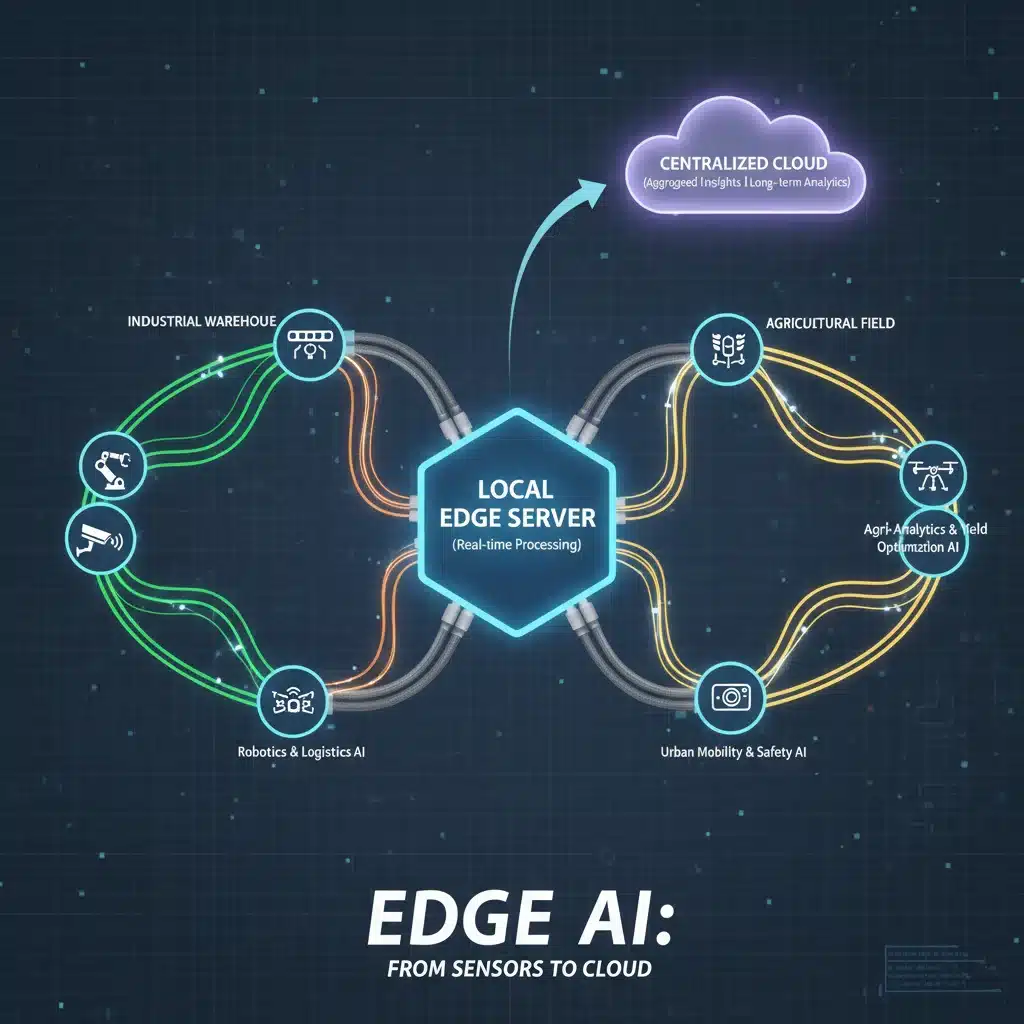
To truly appreciate the potential of Edge AI Deployment, it’s crucial to first grasp what it entails and how it differs from traditional cloud-based AI. At its core, Edge AI refers to the deployment of artificial intelligence algorithms and machine learning models directly onto ‘edge’ devices or local servers, closer to the source of data generation. This contrasts sharply with conventional methods where data is typically sent to a centralized cloud infrastructure for processing and analysis.
Imagine a smart factory floor in the heart of industrial America. In a traditional setup, data from countless sensors on machinery—temperature, pressure, vibration—would be streamed to a distant cloud data center. There, AI models would analyze this colossal dataset to detect anomalies, predict maintenance needs, or optimize production lines. While effective, this process introduces latency, consumes significant bandwidth, and raises concerns about data privacy and security.
With Edge AI Deployment, the processing power and intelligence are brought directly to the factory floor. AI models run on the machines themselves, or on local gateway devices, enabling instantaneous analysis and decision-making. A machine can detect an impending failure second-by-second and alert operators or even initiate self-correction without waiting for a round trip to the cloud. This immediate feedback loop is a game-changer for time-sensitive operations.
The distinction lies in proximity and speed. Edge AI thrives on real-time insights, autonomy, and reduced reliance on constant network connectivity. This architectural shift profoundly impacts how businesses operate, offering unprecedented levels of responsiveness and efficiency.
The Compelling Case for 15% Operational Efficiency Gains by 2026
The promise of a 15% increase in operational efficiency by 2026 through Edge AI Deployment is not an overstatement; it’s a conservative estimate based on the tangible benefits this technology delivers across various sectors. For US businesses striving to remain competitive, these gains translate directly into enhanced profitability, reduced waste, and superior customer experiences.
Real-time Decision Making and Automation
One of the most significant contributions of Edge AI is its ability to facilitate real-time decision-making. In scenarios where every millisecond counts—such as autonomous vehicles, critical infrastructure monitoring, or high-speed manufacturing—the latency inherent in cloud-based processing is a severe impediment. Edge AI eliminates this, allowing devices to analyze data and act instantaneously. This capability fuels greater automation, minimizing human intervention in repetitive or dangerous tasks, thereby freeing up human capital for more strategic endeavors.
Reduced Bandwidth and Cloud Costs
Sending vast quantities of raw data from thousands of edge devices to the cloud is expensive and bandwidth-intensive. Edge AI Deployment significantly mitigates this by processing data locally and only sending aggregated insights or critical events to the cloud. This dramatically reduces data transmission costs and alleviates network congestion, leading to substantial savings on cloud infrastructure and connectivity.
Enhanced Data Security and Privacy
With data processed closer to its source, the exposure of sensitive information to external networks is minimized. This local processing capability is particularly beneficial for industries dealing with confidential customer data, proprietary operational data, or complying with stringent regulatory frameworks like HIPAA or GDPR (even for US businesses operating internationally). By reducing the surface area for cyberattacks and limiting data transit, Edge AI bolsters overall data security and privacy.
Improved Reliability and Resilience
Dependence on constant cloud connectivity can be a single point of failure. If the internet connection drops, cloud-dependent operations cease. Edge AI, by design, offers greater resilience. Edge devices and local servers can continue to operate and make intelligent decisions even in the absence of network connectivity, ensuring business continuity and uninterrupted operations. This makes it ideal for remote locations or environments with unreliable internet access.
Optimized Resource Utilization and Predictive Maintenance
In manufacturing, logistics, and energy sectors, Edge AI Deployment excels at optimizing resource utilization. By continuously monitoring equipment performance, energy consumption, and environmental factors, AI models at the edge can identify inefficiencies, predict equipment failures before they occur, and recommend proactive maintenance. This predictive capability reduces downtime, extends asset lifespan, and optimizes energy usage, directly contributing to the 15% efficiency target.
Key Sectors in the US Poised for Edge AI Transformation
While Edge AI Deployment offers universal benefits, certain sectors within the US economy are particularly ripe for its transformative impact, driving the projected efficiency gains:
- Manufacturing: Predictive maintenance, quality control, robotic automation, supply chain optimization.
- Retail: Inventory management, personalized customer experiences, loss prevention, smart checkout systems.
- Healthcare: Remote patient monitoring, medical imaging analysis at the point of care, smart hospitals, fall detection.
- Energy & Utilities: Smart grid management, predictive maintenance for infrastructure, energy consumption optimization.
- Transportation & Logistics: Autonomous vehicles, traffic management, fleet optimization, warehouse automation.
- Agriculture: Precision farming, crop monitoring, livestock management, automated irrigation.
Each of these sectors can leverage Edge AI to address specific pain points, streamline processes, and unlock new levels of operational excellence, all contributing to the overarching goal of a 15% efficiency boost.
A Practical Roadmap for Edge AI Deployment in US Businesses
Implementing Edge AI Deployment is a strategic journey that requires careful planning, execution, and continuous optimization. Here’s a practical roadmap for US businesses:
Phase 1: Strategic Planning and Use Case Identification (Q1-Q2 2024)
- Define Business Objectives: Clearly articulate what you aim to achieve with Edge AI. Is it reducing downtime, improving product quality, enhancing customer safety, or cutting operational costs? Specific, measurable goals are crucial.
- Identify High-Impact Use Cases: Conduct a thorough assessment of your current operations to pinpoint areas where Edge AI can deliver the most significant value. Start with use cases that have a clear ROI and are relatively contained in scope to build early success. Examples include predictive maintenance on a critical production line, real-time quality inspection, or intelligent surveillance.
- Form a Cross-Functional Team: Assemble a team comprising IT, operations, data science, and business unit leaders. This ensures holistic planning and addresses technical, operational, and strategic considerations.
- Feasibility Study and ROI Projection: For identified use cases, conduct a detailed feasibility study and project the potential return on investment. This includes estimating the 15% efficiency gain and quantifying its financial impact.
Phase 2: Technology Stack Selection and Pilot Program (Q3-Q4 2024)
- Choose Edge Hardware: Select appropriate edge devices (e.g., industrial PCs, IoT gateways, specialized AI chips, embedded systems) based on computational power, ruggedness, connectivity options, and cost. Consider factors like power consumption and environmental conditions.
- Select Edge AI Software Platform: Evaluate various Edge AI platforms and frameworks. These platforms provide tools for model deployment, management, and orchestration at the edge. Factors to consider include ease of integration, scalability, security features, and support for your chosen AI models.
- Develop/Adapt AI Models: Either develop new AI models optimized for edge deployment or adapt existing cloud-based models. This often involves techniques like model quantization, pruning, and knowledge distillation to reduce model size and computational requirements without significantly sacrificing accuracy.
- Data Collection and Annotation Strategy: Implement a robust strategy for collecting and, if necessary, annotating the data required to train and validate your Edge AI models. Ensure data quality and relevance.
- Pilot Program Execution: Launch a small-scale pilot program for a selected high-impact use case. This allows for real-world testing, identification of unforeseen challenges, and refinement of the solution in a controlled environment.
Phase 3: Scaled Deployment and Integration (2025)
- Secure and Network Edge Devices: Implement robust cybersecurity measures for all edge devices and establish secure network connectivity. This includes encryption, access control, and continuous monitoring.
- Integrate with Existing Systems: Seamlessly integrate Edge AI solutions with your existing IT infrastructure, operational technology (OT) systems, and enterprise applications (e.g., ERP, MES, CRM). This ensures data flow and operational coherence.
- Deployment and Monitoring Tools: Utilize centralized management tools for deploying, updating, and monitoring Edge AI models across multiple devices. This is critical for managing a large-scale deployment efficiently.
- Performance Monitoring and Optimization: Continuously monitor the performance of your Edge AI systems. Track key metrics, analyze data, and iterate on models and configurations to achieve optimal efficiency gains. This iterative process is key to reaching and exceeding the 15% target.
Phase 4: Continuous Improvement and Expansion (2026 and Beyond)
- Feedback Loops and Model Retraining: Establish continuous feedback loops to gather performance data and retrain AI models as new data becomes available or operational conditions change. This ensures the models remain accurate and relevant.
- Scalability Planning: Plan for future expansion by designing your Edge AI architecture to be scalable. Consider how new devices, models, and use cases can be seamlessly integrated.
- Skill Development and Training: Invest in upskilling your workforce to manage, operate, and innovate with Edge AI technologies. This includes training for data scientists, engineers, and operational staff.
- Explore New Opportunities: As your organization gains expertise, continuously explore new opportunities for Edge AI Deployment to unlock further efficiency gains and innovative business models.
Overcoming Challenges in Edge AI Deployment
While the benefits are substantial, US businesses must be prepared to navigate several challenges during Edge AI Deployment:
1. Hardware and Software Compatibility
The vast array of edge devices and software platforms can lead to compatibility issues. Ensuring seamless integration requires careful planning and often custom development. Standardized protocols and open-source solutions can help mitigate this.
2. Data Management and Governance
Managing data at the edge, from collection to storage and processing, presents its own complexities. Establishing robust data governance policies, including data quality, security, and privacy, is paramount.
3. Model Optimization for Edge Devices
AI models trained in the cloud often require significant optimization to run efficiently on resource-constrained edge devices. Techniques like model compression and specialized inference engines are crucial.
4. Security at the Edge
Edge devices are often physically exposed and can be vulnerable to tampering or cyberattacks. Implementing multi-layered security measures, including hardware-level security, secure boot, and continuous threat monitoring, is essential for secure Edge AI Deployment.
5. Connectivity and Network Infrastructure
While Edge AI reduces cloud reliance, reliable local network infrastructure (e.g., 5G, Wi-Fi 6, private LTE) is still vital for data aggregation, model updates, and communication with central systems. Investing in robust network infrastructure is a prerequisite.
6. Talent Gap
A significant challenge is the shortage of skilled professionals proficient in both AI/ML and edge computing. US businesses must invest in training existing staff or attract new talent to bridge this gap.

Measuring Success: KPIs for 15% Efficiency Gains
To confirm the 15% operational efficiency gains from your Edge AI Deployment, it’s vital to establish clear Key Performance Indicators (KPIs) and regularly monitor them. These might include:
- Overall Equipment Effectiveness (OEE): A composite measure of availability, performance, and quality. Edge AI can significantly boost all three.
- Downtime Reduction: Track the reduction in unplanned equipment downtime due to predictive maintenance.
- Energy Consumption: Monitor decreases in energy usage through optimized processes.
- Waste Reduction: Measure the reduction in material waste or defective products.
- Throughput Increase: Quantify the increase in production volume or service delivery speed.
- Labor Cost Savings: Analyze the savings from automating repetitive tasks and optimizing human resource allocation.
- Bandwidth and Cloud Cost Savings: Directly measure the reduction in data transmission and cloud processing expenses.
- Mean Time To Repair (MTTR): Track improvements in the time it takes to repair equipment failures.
Regular analysis of these KPIs will provide tangible evidence of the efficiency improvements and guide further optimization efforts, ensuring the 15% target is not only met but potentially exceeded.
The Future of US Business with Edge AI
The journey towards 15% operational efficiency gains through Edge AI Deployment is more than just a technological upgrade; it’s a strategic imperative for US businesses. As competition intensifies globally and the demand for real-time responsiveness grows, Edge AI offers a pathway to unprecedented levels of agility, innovation, and resilience.
Businesses that embrace this paradigm shift will not only optimize existing operations but also unlock new possibilities for product development, service delivery, and customer engagement. The ability to process and act on data at the point of origin transforms data from a passive asset into an active, intelligent agent driving continuous improvement.
By carefully planning, methodically executing, and continuously optimizing their Edge AI strategies, US businesses can confidently navigate the complexities of the modern industrial landscape, secure a leading position in their respective markets, and achieve the ambitious goal of a 15% boost in operational efficiency by 2026. The future is intelligent, distributed, and at the edge – are you ready to deploy?
Conclusion
The imperative for US businesses to enhance operational efficiency is stronger than ever. Edge AI Deployment offers a powerful, practical, and proven pathway to achieving significant gains, with a realistic target of 15% by 2026. By bringing intelligence closer to the data source, businesses can unlock real-time decision-making, reduce costs, bolster security, and improve overall resilience. The roadmap outlined in this guide provides a strategic framework, from identifying high-impact use cases to scaled deployment and continuous optimization. While challenges exist, they are surmountable with careful planning and strategic investment in technology and talent. Embrace Edge AI, and position your business at the forefront of the next wave of industrial and technological transformation.