Predictive Analytics in Healthcare: Boosting Patient Outcomes by 18% with AI by 2027

Predictive Analytics in Healthcare: Boosting Patient Outcomes by 18% with AI by 2027
The landscape of healthcare is undergoing a profound transformation, driven by an unprecedented influx of data and the relentless advancement of artificial intelligence. At the heart of this revolution lies predictive analytics in healthcare, a powerful methodology that utilizes historical data to forecast future events and trends. This isn’t just about identifying patterns; it’s about anticipating needs, preventing crises, and ultimately, delivering more personalized and effective care. Experts predict that by 2027, the strategic integration of AI-powered predictive analytics could lead to an astounding 18% improvement in patient outcomes across US hospitals. This bold projection underscores the immense potential of this technology to reshape how we approach health and wellness, moving from reactive treatment to proactive prevention and personalized intervention.
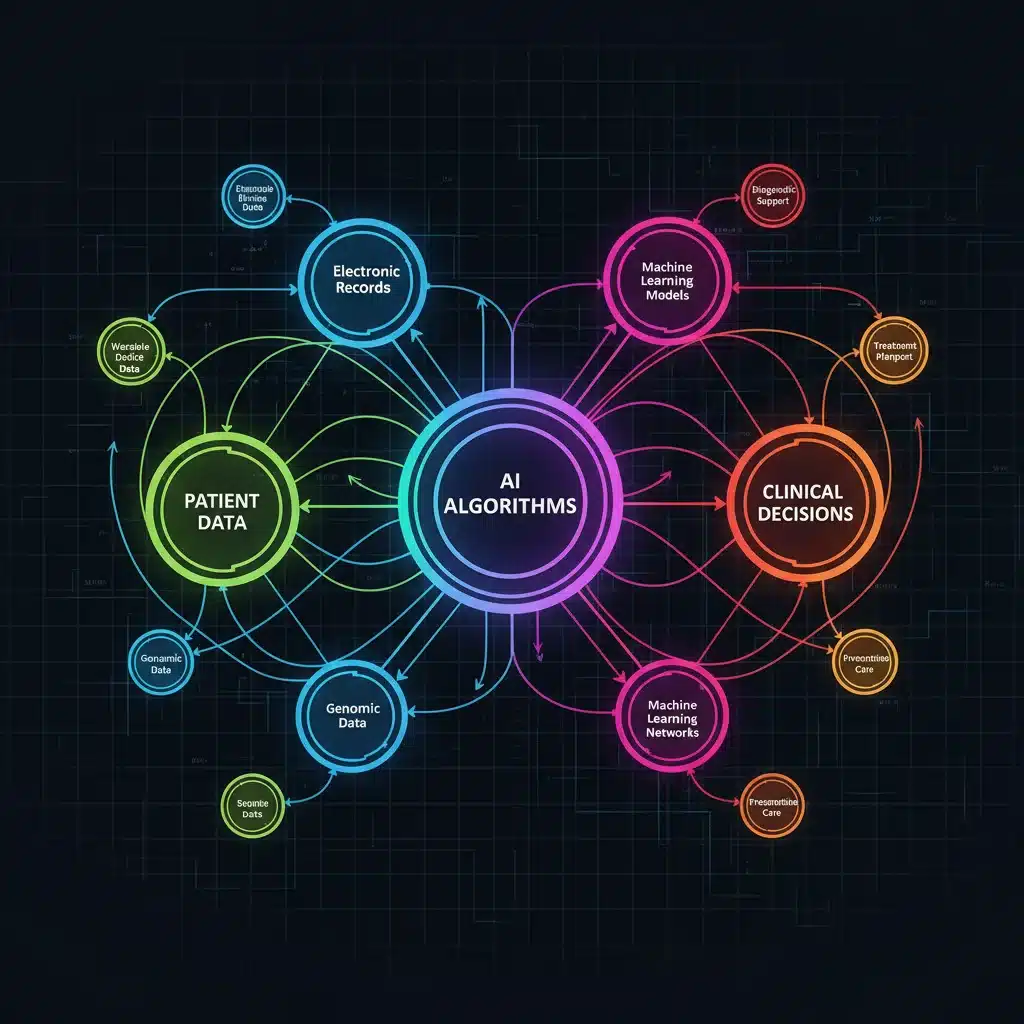
The journey towards this future is already well underway. Hospitals, clinics, and research institutions are increasingly turning to sophisticated algorithms to make sense of vast datasets, ranging from electronic health records (EHRs) and genomic information to wearable device data and social determinants of health. By analyzing these diverse data streams, predictive analytics can identify individuals at high risk of developing certain conditions, forecast disease outbreaks, optimize resource allocation, and even personalize treatment plans down to the individual patient. The goal is clear: to empower healthcare providers with actionable insights that lead to better patient experiences, reduced costs, and, most importantly, significantly improved health outcomes.
This article delves deep into the world of predictive analytics in healthcare, exploring its foundational principles, diverse applications, and the transformative impact it is already having and promises to continue having on the industry. We will examine the technologies that power it, the ethical considerations it raises, and the strategic roadmap for its widespread adoption. Join us as we uncover how AI is not just a tool but a fundamental partner in achieving a healthier future for all.
Understanding Predictive Analytics: The Foundation of Future Healthcare
At its core, predictive analytics in healthcare is about leveraging data to make informed predictions about future health events. This involves a complex interplay of statistical modeling, machine learning algorithms, and historical data analysis. Unlike traditional descriptive analytics, which tells us what happened, or diagnostic analytics, which explains why it happened, predictive analytics aims to answer the crucial question: ‘What will happen next?’
The process typically begins with collecting and aggregating vast amounts of healthcare data. This data can come from numerous sources: electronic health records (EHRs) containing patient demographics, medical history, diagnoses, treatments, and laboratory results; claims data; pharmaceutical records; imaging data; and even real-time data from remote monitoring devices and wearables. The sheer volume and variety of this data make it an ideal candidate for AI and machine learning techniques, which excel at identifying complex patterns and relationships that human analysis might miss.
Key Components of Predictive Analytics
- Data Collection and Integration: The first step involves gathering heterogeneous data from various sources and integrating it into a unified, accessible format. This often requires robust data warehousing and data lake solutions.
- Data Preprocessing and Feature Engineering: Raw data is often noisy, incomplete, or inconsistent. Preprocessing involves cleaning, transforming, and structuring the data. Feature engineering then extracts relevant attributes or ‘features’ that are most useful for building predictive models.
- Model Development: This is where machine learning algorithms come into play. Techniques such as regression analysis, classification algorithms (e.g., logistic regression, support vector machines, decision trees, random forests), neural networks, and deep learning are trained on historical data to learn the relationships between input variables and the outcomes of interest.
- Model Validation and Evaluation: Once developed, models are rigorously tested on unseen data to assess their accuracy, precision, recall, and other performance metrics. This ensures the model is reliable and generalizable.
- Deployment and Monitoring: Validated models are then integrated into clinical workflows and IT systems. Continuous monitoring is crucial to ensure the model’s performance doesn’t degrade over time due to changes in data patterns or patient populations.
The power of predictive analytics in healthcare lies in its ability to move beyond simple correlations to uncover causal or highly influential relationships, enabling healthcare providers to anticipate patient needs and intervene proactively. This shift from reactive to proactive care is perhaps the most significant promise of this technology.
Transforming Patient Outcomes: The 18% Improvement Goal
The projection of an 18% improvement in patient outcomes by 2027 is not merely an optimistic forecast; it’s a reflection of the tangible benefits already being realized and the accelerating pace of innovation in AI and healthcare. This significant improvement is expected to manifest across various dimensions of patient care, including reduced readmission rates, earlier disease detection, more effective treatment strategies, and enhanced patient safety.
Areas of Impact for Predictive Analytics
- Early Disease Detection and Risk Stratification: AI models can analyze a patient’s medical history, genetic predispositions, lifestyle factors, and real-time biometric data to identify early markers of disease development. For instance, predictive models can flag patients at high risk for sepsis, heart failure exacerbations, or diabetic complications, allowing for timely interventions before conditions become critical.
- Personalized Treatment Plans: By analyzing vast amounts of data on treatment efficacy for similar patient profiles, predictive analytics can help tailor therapies to individual patients. This precision medicine approach ensures that patients receive the most effective drugs and interventions, minimizing trial-and-error and improving response rates.
- Optimizing Hospital Operations and Resource Allocation: Predictive models can forecast patient admission rates, emergency room volumes, and demand for specific medical services. This allows hospitals to optimize staffing levels, manage bed availability, and allocate resources more efficiently, reducing wait times and improving the overall patient experience.
- Reducing Readmissions: Hospital readmissions are a significant burden on healthcare systems and often indicate suboptimal post-discharge care. Predictive analytics can identify patients at high risk of readmission, enabling targeted interventions such as enhanced follow-up care, patient education, and home health support.
- Preventing Medical Errors: By analyzing patterns in medication orders, diagnostic interpretations, and procedural steps, AI can identify potential errors before they occur, significantly enhancing patient safety.
- Managing Chronic Diseases: For patients with chronic conditions like diabetes, hypertension, or asthma, predictive analytics can monitor disease progression, anticipate exacerbations, and prompt timely adjustments to care plans, leading to better long-term management and quality of life.
The cumulative effect of these improvements is what drives the projected 18% increase in patient outcomes. It’s a holistic enhancement of the care continuum, touching every stage from prevention and diagnosis to treatment and post-discharge recovery. The ethical deployment of predictive analytics in healthcare is paramount to realizing these benefits responsibly.
Key Technologies Powering Predictive Analytics in Healthcare
The success of predictive analytics in healthcare hinges on a sophisticated stack of technologies that enable data collection, processing, analysis, and deployment. Understanding these underlying technologies is crucial to appreciating the capabilities and potential of AI in medicine.
Artificial Intelligence and Machine Learning
At the forefront are AI and machine learning (ML) algorithms. These are the engines that learn from data and make predictions. Key ML techniques include:
- Supervised Learning: This involves training models on labeled data, where the desired output is known. Examples include predicting disease diagnosis (classification) or forecasting patient length of stay (regression).
- Unsupervised Learning: Used for finding hidden patterns and structures in unlabeled data, such as clustering patients into distinct risk groups based on their health profiles.
- Deep Learning: A subset of machine learning that uses neural networks with multiple layers to learn complex representations of data. Deep learning is particularly effective for analyzing unstructured data like medical images, natural language processing (NLP) of clinical notes, and genomic sequences.
- Reinforcement Learning: While less common in current clinical applications, reinforcement learning has potential for optimizing treatment protocols by learning from trial-and-error in simulated environments.
Big Data Technologies
Healthcare data is inherently ‘big’ – characterized by its volume, velocity, variety, veracity, and value. Managing and processing this data requires specialized big data technologies:
- Data Warehouses and Data Lakes: These systems store and manage vast amounts of structured and unstructured healthcare data, making it accessible for analysis.
- Cloud Computing: Provides scalable and flexible infrastructure for storing, processing, and analyzing massive datasets, without the need for large upfront hardware investments. Major cloud providers offer specialized healthcare AI services.
- Distributed Computing Frameworks: Tools like Apache Hadoop and Apache Spark enable the processing of large datasets across clusters of computers, significantly speeding up analytical tasks.
Natural Language Processing (NLP)
A significant portion of valuable clinical information resides in unstructured text format within electronic health records, physician notes, and research papers. NLP techniques allow AI systems to understand, interpret, and extract meaningful insights from this textual data. This is vital for tasks such as identifying symptoms, diagnoses, and treatments mentioned in free-text notes, which can then be used as features for predictive models.
Internet of Medical Things (IoMT) and Wearables
The proliferation of connected medical devices and wearable sensors generates real-time physiological data, offering a continuous stream of information for predictive models. This includes heart rate, blood pressure, glucose levels, activity levels, and sleep patterns. IoMT data can enable continuous risk assessment and proactive alerts for impending health issues.
Interoperability and Data Standards
For predictive analytics to be truly effective, data must flow seamlessly between different systems and organizations. Standards like FHIR (Fast Healthcare Interoperability Resources) are critical for ensuring data interoperability, allowing diverse healthcare systems to communicate and share information in a standardized format. This is a foundational requirement for building comprehensive predictive models across patient populations.
The convergence of these technologies creates a powerful ecosystem for predictive analytics in healthcare, enabling the development of increasingly sophisticated and accurate models that can genuinely impact patient care.
Applications of Predictive Analytics in US Hospitals
The practical applications of predictive analytics in healthcare are vast and continue to expand. US hospitals are increasingly adopting these tools to address some of their most pressing challenges, from improving clinical outcomes to enhancing operational efficiency and financial stability.
Clinical Applications
- Sepsis Prediction: Sepsis is a life-threatening condition that requires rapid intervention. Predictive models can analyze vital signs, lab results, and clinical notes to identify patients at risk of developing sepsis hours before clinical deterioration, allowing for early treatment and significantly improving survival rates.
- Heart Failure Management: AI can predict readmission risk for heart failure patients by analyzing factors like medication adherence, comorbidities, and social determinants of health. This enables targeted post-discharge support and personalized care plans to prevent readmissions.
- Diabetic Retinopathy Detection: Deep learning algorithms can analyze retinal scans to detect early signs of diabetic retinopathy, a leading cause of blindness, often with an accuracy comparable to or exceeding human ophthalmologists.
- Oncology: Predictive models can assist in cancer diagnosis, prognosis, and treatment selection by analyzing genomic data, imaging results, and patient responses to various therapies. This leads to more personalized and effective cancer care.
- Infection Control: By analyzing patient movement patterns, hospital occupancy, and epidemiological data, predictive analytics can forecast potential outbreaks of hospital-acquired infections (HAIs), enabling proactive infection control measures.
Operational and Administrative Applications
- Workforce Management: Hospitals can use predictive analytics to forecast patient volumes and staffing needs across different departments, optimizing nurse and physician scheduling to ensure adequate coverage and prevent burnout.
- Supply Chain Optimization: Predicting demand for medical supplies, medications, and equipment helps hospitals manage inventory more effectively, reducing waste and ensuring critical items are always available.
- Financial Forecasting: Predictive models can forecast revenue, expenses, and reimbursement rates, helping hospital administrators make informed financial decisions and manage budgets more effectively.
- Patient Flow Optimization: By predicting patient admissions, discharges, and transfers, hospitals can optimize patient flow through various units, reducing bottlenecks, improving bed turnover, and enhancing the overall patient experience.
These examples illustrate how predictive analytics in healthcare is not just a theoretical concept but a practical tool delivering measurable improvements across the healthcare ecosystem. The integration of these tools into daily clinical and administrative operations is key to achieving the ambitious 18% improvement in patient outcomes.

Challenges and Ethical Considerations
While the promise of predictive analytics in healthcare is immense, its widespread adoption also comes with significant challenges and ethical considerations that must be addressed carefully.
Data Privacy and Security
Healthcare data is highly sensitive. Protecting patient privacy and ensuring the security of vast datasets are paramount. Compliance with regulations like HIPAA (Health Insurance Portability and Accountability Act) in the US is non-negotiable. Robust encryption, access controls, and de-identification techniques are essential to prevent data breaches and misuse.
Bias in Algorithms and Data
AI models are only as good as the data they are trained on. If historical healthcare data contains biases (e.g., underrepresentation of certain demographic groups, historical disparities in care), the predictive models can perpetuate or even amplify these biases, leading to inequitable outcomes. Addressing algorithmic bias requires careful data curation, model auditing, and fairness-aware AI development.
Interpretability and Explainability (XAI)
Many advanced AI models, particularly deep learning networks, are often considered ‘black boxes’ because their decision-making processes are not easily understood by humans. In healthcare, clinicians need to understand why a model made a particular prediction to trust and act upon its recommendations. The field of Explainable AI (XAI) is focused on developing methods to make AI models more transparent and interpretable.
Integration into Clinical Workflow
Developing powerful predictive models is one thing; seamlessly integrating them into busy clinical workflows is another. Healthcare professionals are already burdened with administrative tasks. AI tools must be intuitive, user-friendly, and provide actionable insights without adding significant cognitive load or disrupting established routines.
Regulatory and Legal Frameworks
As AI becomes more prevalent in healthcare, new regulatory and legal frameworks are needed to govern its development, deployment, and accountability. Questions arise regarding liability when an AI system makes an incorrect prediction that leads to adverse patient outcomes. The FDA in the US is actively working on guidelines for AI as a medical device.
Cost and Infrastructure
Implementing advanced predictive analytics solutions requires significant investment in technology infrastructure, data scientists, and clinical informaticists. Smaller hospitals or those with limited IT budgets may face barriers to adoption.
Trust and Acceptance
Both healthcare providers and patients need to trust AI systems. Building this trust requires demonstrating the reliability, accuracy, and fairness of these tools, along with clear communication about their capabilities and limitations. Over-reliance or blind trust in AI can also be dangerous.
Addressing these challenges is not merely a technical exercise but a multidisciplinary endeavor involving clinicians, data scientists, ethicists, policymakers, and patients. Only through thoughtful and collaborative effort can the full potential of predictive analytics in healthcare be realized responsibly.
The Future of Predictive Analytics in Healthcare
The journey towards achieving an 18% improvement in patient outcomes by 2027 through predictive analytics in healthcare is an ambitious yet attainable goal. The future promises even more sophisticated applications and a deeper integration of AI into every facet of patient care.
Towards Proactive and Personalized Health
The trajectory is clear: moving from treating illness to maintaining wellness. Predictive analytics will increasingly focus on population health management, identifying communities and individuals at risk for chronic diseases or public health crises. This proactive approach will involve integrating data from diverse sources, including environmental factors, socioeconomic determinants, and individual behavioral patterns, to create highly personalized health interventions.
Digital Twins in Healthcare
Imagine creating a ‘digital twin‘ of each patient – a virtual replica of their physiological and genetic makeup, continuously updated with real-time data from wearables, EHRs, and other sources. Predictive models could then simulate the effects of different treatments or lifestyle changes on this digital twin, allowing clinicians to precisely tailor therapies and anticipate outcomes before administering them to the actual patient. This is a powerful vision for truly personalized medicine.
Augmented Intelligence for Clinicians
The future of AI in healthcare is not about replacing human clinicians but augmenting their capabilities. Predictive analytics tools will act as intelligent assistants, providing clinicians with comprehensive, data-driven insights at the point of care. This ‘augmented intelligence’ will help clinicians make faster, more accurate decisions, reduce cognitive load, and free up time for direct patient interaction and empathy.
Ethical AI and Human-Centered Design
As AI becomes more pervasive, there will be an even greater emphasis on ethical AI development and human-centered design principles. This means building AI systems that are fair, transparent, accountable, and designed with the needs and values of patients and providers at their core. Public discourse and policy development around AI ethics in healthcare will continue to evolve, ensuring that technological progress aligns with societal values.
Continuous Learning and Adaptation
Predictive models will not be static. They will continuously learn and adapt from new data, improving their accuracy and relevance over time. This continuous learning loop will ensure that healthcare systems remain at the cutting edge of medical knowledge and can respond dynamically to emerging health challenges.
The convergence of advanced AI, vast datasets, and a growing understanding of human biology is setting the stage for a new era in healthcare. Predictive analytics in healthcare is not just a trend; it’s a fundamental shift in how we understand, manage, and improve human health. The 18% improvement in patient outcomes by 2027 is just the beginning of what promises to be a transformative journey towards a healthier, more equitable, and more efficient healthcare system.
Conclusion
The journey towards a healthcare system empowered by predictive analytics in healthcare is well underway, promising a future where proactive, personalized care is the norm rather than the exception. The ambitious goal of improving patient outcomes by 18% in US hospitals by 2027 is a testament to the transformative power of AI and machine learning when applied to the complex world of medicine.
From early disease detection and personalized treatment plans to optimized hospital operations and reduced readmissions, predictive analytics is revolutionizing every facet of healthcare delivery. By leveraging vast reservoirs of data and sophisticated algorithms, healthcare providers can gain unprecedented insights, enabling them to anticipate patient needs, mitigate risks, and make more informed decisions. This shift from reactive treatment to proactive prevention and precision intervention is fundamentally reshaping the patient experience and driving significant improvements in health outcomes.
However, realizing this potential requires navigating significant challenges, including ensuring data privacy and security, addressing algorithmic bias, promoting model interpretability, and seamlessly integrating these tools into existing clinical workflows. Ethical considerations, robust regulatory frameworks, and a commitment to human-centered design are paramount to building trust and ensuring that AI serves humanity’s best interests.
As we look to the future, the continuous evolution of AI, coupled with advancements in data science and medical research, promises even more sophisticated applications, such as digital twins and augmented intelligence for clinicians. The vision is clear: AI will not replace the human touch in medicine but will empower healthcare professionals with unprecedented capabilities, allowing them to deliver care that is more precise, efficient, and compassionate than ever before. The 18% improvement in patient outcomes is not just a statistic; it represents countless lives positively impacted, a more sustainable healthcare system, and a healthier society for generations to come. The era of intelligent healthcare is here, and predictive analytics in healthcare is leading the charge.