Web3 Infrastructure: Powering US Digital Services & Data Ownership by 2027

The internet, as we know it today, often referred to as Web2, has undeniably transformed our lives. From instant communication to global commerce, its impact is profound. However, this centralized model also presents significant challenges: data breaches, privacy concerns, and the concentration of power in a few large corporations. Enter Web3, the next evolutionary stage of the internet, promising a decentralized, secure, and user-centric digital experience. In the United States, the development and adoption of Web3 Infrastructure US is not merely a technological trend; it’s a fundamental shift poised to redefine digital services and empower individuals with true data ownership within the next three years.
The vision for Web3 is ambitious: an internet built on decentralized protocols, where users, not intermediaries, control their data and digital identities. This paradigm shift holds immense potential for various sectors, from finance and healthcare to government services and entertainment. The US, with its strong innovation ecosystem and burgeoning tech sector, is at the forefront of exploring and implementing these transformative technologies. By 2027, we anticipate a significant maturation of Web3 Infrastructure US, paving the way for a new era of digital interaction.
Understanding Web3 Infrastructure: The Building Blocks of Decentralization
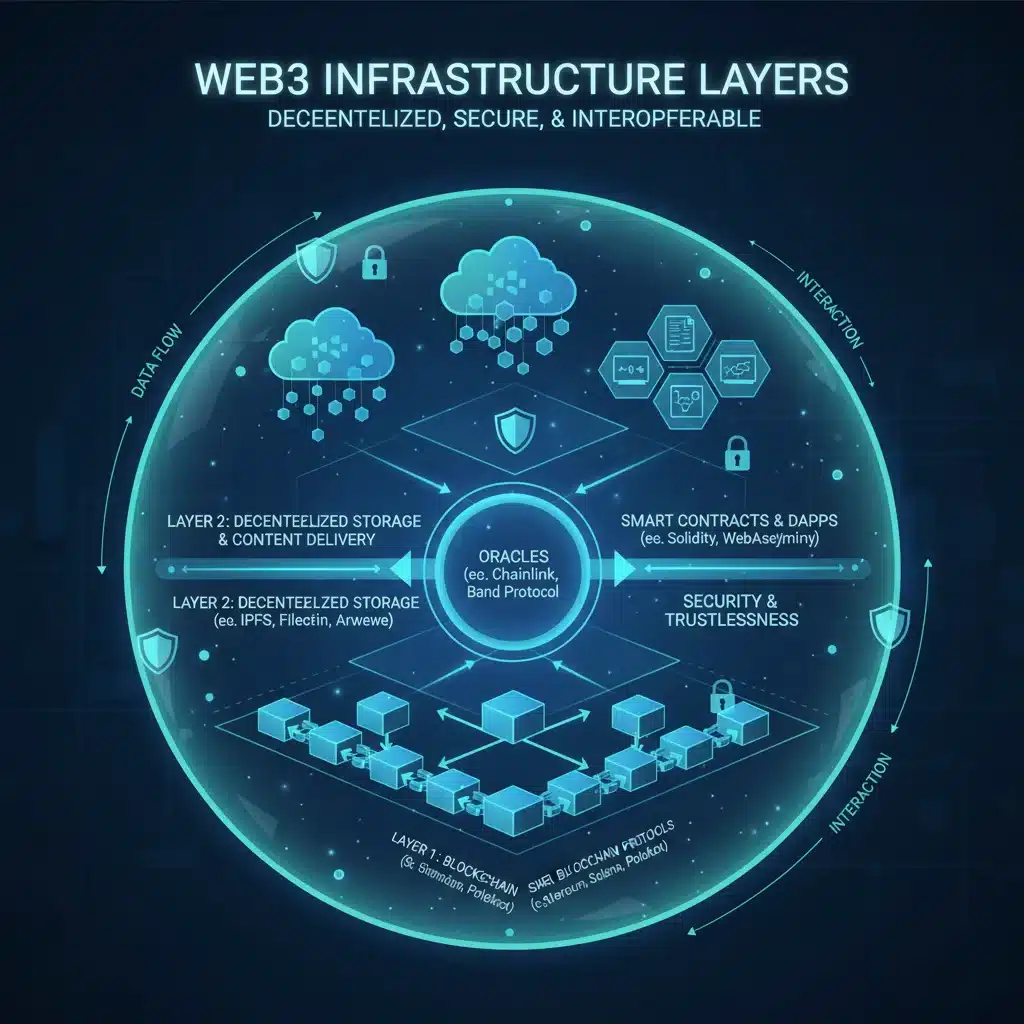
At its core, Web3 infrastructure refers to the underlying technological components that enable decentralized applications (dApps) and services. Unlike Web2, which relies heavily on centralized servers and databases, Web3 leverages distributed ledger technologies (DLTs), primarily blockchain, to create a more transparent, immutable, and secure environment. This foundational shift has profound implications for how digital services are built, operated, and accessed.
Key components of Web3 Infrastructure US include:
- Blockchain Protocols: These are the backbone of Web3, providing a decentralized and immutable ledger for transactions and data. Examples include Ethereum, Solana, Polygon, and Avalanche, each offering different trade-offs in terms of scalability, security, and decentralization. The choice of protocol often depends on the specific use case and the requirements of the dApp.
- Decentralized Storage: Instead of storing data on central servers, Web3 utilizes decentralized storage networks like IPFS (InterPlanetary File System) and Filecoin. This distributes data across multiple nodes, making it more resilient to censorship and single points of failure, and enhancing data ownership.
- Smart Contracts: Self-executing contracts with the terms of the agreement directly written into code. Smart contracts automate processes, reduce the need for intermediaries, and are fundamental to the functionality of many dApps, from decentralized finance (DeFi) to supply chain management.
- Oracles: These are third-party services that provide smart contracts with external real-world data. Since blockchains are isolated systems, oracles act as bridges, feeding information such as price feeds, weather data, or event outcomes, enabling smart contracts to interact with the outside world.
- Decentralized Identifiers (DIDs): A new type of identifier that enables verifiable, decentralized digital identity. DIDs give individuals control over their personal information and how it’s shared, a cornerstone of data ownership in Web3.
- Layer 2 Solutions: Designed to improve the scalability and efficiency of main blockchain networks (Layer 1s). Layer 2 solutions like rollups (optimistic and zero-knowledge) process transactions off-chain and then post aggregated data back to the main chain, significantly increasing transaction throughput and reducing costs.
- Interoperability Protocols: As the Web3 ecosystem grows, the ability for different blockchains to communicate and exchange assets is crucial. Protocols like Polkadot and Cosmos are building bridges to facilitate seamless interaction between disparate networks, fostering a more connected decentralized internet.
The development of these components is critical for establishing robust Web3 Infrastructure US. The US has a vibrant community of developers, researchers, and startups actively contributing to these advancements, pushing the boundaries of what’s possible in the decentralized space.
Redefining US Digital Services with Decentralization
The implications of a mature Web3 Infrastructure US for digital services are vast and transformative. We can expect to see significant shifts in how various sectors operate, moving towards more transparent, secure, and user-centric models.
Financial Services: The Rise of DeFi and Beyond
Decentralized Finance (DeFi) is arguably the most prominent application of Web3 to date. By leveraging blockchain and smart contracts, DeFi platforms offer financial services like lending, borrowing, trading, and insurance without traditional intermediaries. In the US, the regulatory landscape for DeFi is still evolving, but the potential for greater financial inclusion, lower transaction costs, and increased transparency is undeniable. Over the next three years, we could see:
- Increased adoption of stablecoins: Digital currencies pegged to the US dollar, facilitating faster and cheaper cross-border payments and remittances.
- Tokenized real-world assets: Representation of physical assets (like real estate or art) as digital tokens on a blockchain, enabling fractional ownership and increased liquidity.
- Decentralized autonomous organizations (DAOs) in finance: Community-governed protocols that democratize decision-making in financial products and services.
The integration of Web3 Infrastructure US into mainstream financial systems will require careful navigation of regulatory frameworks, but the benefits of a more open and efficient financial system are a powerful driver.
Healthcare: Secure Data Management and Patient Empowerment
Healthcare is a sector plagued by data silos, interoperability issues, and privacy concerns. Web3 offers compelling solutions:
- Secure electronic health records (EHRs): Blockchain can provide an immutable and auditable record of patient data, enhancing security and preventing tampering. Patients could control who accesses their data, improving privacy.
- Decentralized clinical trials: Smart contracts can automate consent processes, data collection, and payments in clinical trials, increasing efficiency and transparency.
- Supply chain for pharmaceuticals: Tracking drugs from manufacturing to patient using blockchain can combat counterfeiting and improve supply chain integrity.
The implementation of Web3 Infrastructure US in healthcare promises to empower patients, streamline operations, and build a more trustworthy health data ecosystem.
Government and Public Services: Transparency and Efficiency
Governments can leverage Web3 to enhance transparency, reduce corruption, and improve the delivery of public services:
- Digital identity systems: Decentralized IDs can provide secure and verifiable digital identities for citizens, simplifying access to government services and reducing identity fraud.
- Voting systems: Blockchain-based voting could offer greater transparency, immutability, and auditability, increasing public trust in electoral processes.
- Land registries and public records: Immutably recording property ownership and other public records on a blockchain can reduce disputes and streamline administrative processes.
The potential for Web3 Infrastructure US to create more efficient and accountable public services is a significant area of focus for innovation.
Supply Chain and Logistics: Traceability and Trust
The complexities of global supply chains make them ideal candidates for Web3 integration. Blockchain can provide an immutable record of product origin, movement, and ownership, enhancing transparency and trust:
- Product traceability: Consumers can verify the authenticity and ethical sourcing of products by scanning QR codes linked to blockchain data.
- Fraud prevention: Reducing counterfeit goods and ensuring product integrity across the supply chain.
- Automated payments: Smart contracts can automate payments upon delivery or verification of goods, streamlining logistics and reducing delays.
By strengthening supply chain visibility, Web3 Infrastructure US can offer significant benefits to businesses and consumers alike.
Empowering Data Ownership: A Fundamental Shift
One of the most compelling promises of Web3 is the return of data ownership to the individual. In the Web2 era, users often surrender control of their data to large platforms in exchange for services. This data is then monetized, often without the explicit consent or benefit of the user. Web3 seeks to reverse this paradigm.
With Web3, individuals gain cryptographic control over their digital assets and personal information. This is facilitated by technologies like DIDs and decentralized storage. Instead of data residing on a company’s server, it can be stored on decentralized networks, accessible only by the user’s private key. This means:
- Self-sovereign identity: Users control their digital identity and decide which information to share with whom, rather than relying on centralized identity providers.
- Monetization of personal data: Individuals could potentially earn rewards for sharing their data with specific applications or researchers, rather than companies profiting from it exclusively.
- Enhanced privacy: By storing data on decentralized networks and using cryptographic proofs, individuals can participate in digital services with a higher degree of privacy.
- Resistance to censorship: Data stored on decentralized networks is more resilient to censorship or deletion by any single entity.
The shift towards data ownership is not just a technical change; it’s a philosophical one. It represents a move from a hierarchical, platform-centric internet to a more egalitarian, user-centric one. For Web3 Infrastructure US to truly flourish, this principle of data ownership must be deeply embedded in its design and implementation.
Challenges and the Road Ahead for Web3 Infrastructure US (Next 3 Years)
While the potential of Web3 is immense, its widespread adoption and the full realization of its benefits in the US face several significant challenges. Over the next three years, addressing these will be crucial for the maturation of Web3 Infrastructure US.
Scalability and Performance
Current blockchain networks, particularly those emphasizing decentralization, often struggle with scalability. Processing a high volume of transactions quickly and affordably remains a hurdle. While Layer 2 solutions are making progress, further advancements in consensus mechanisms, sharding, and other scaling technologies are needed to handle the demands of mainstream digital services in the US.
User Experience (UX) and Accessibility
Web3 applications can be complex for the average user, involving concepts like seed phrases, gas fees, and wallet management. For widespread adoption, the user experience must become as seamless and intuitive as Web2. This includes developing more user-friendly wallets, simplifying transaction processes, and providing better educational resources. A focus on abstracting away the technical complexities will be vital for Web3 Infrastructure US to reach a broader audience.
Regulatory Clarity and Compliance
The regulatory landscape for Web3 technologies in the US is still evolving. Uncertainty around classification of digital assets, consumer protection, and anti-money laundering (AML) / know-your-customer (KYC) requirements creates friction for innovation and adoption. Clear and consistent regulatory frameworks are essential to foster confidence among businesses and consumers and to allow Web3 Infrastructure US to grow responsibly.
Security and Interoperability
While blockchain offers inherent security advantages, smart contract vulnerabilities, phishing attacks, and other cyber threats remain concerns. Continuous innovation in security audits, formal verification, and best practices is necessary. Furthermore, the ability for different blockchain networks and Web2 systems to interact seamlessly (interoperability) is critical for a truly connected Web3 ecosystem. Developing robust bridges and standardized protocols will be a key focus.
Environmental Concerns
Proof-of-Work (PoW) blockchains, like early Ethereum and Bitcoin, consume significant energy. The transition to more energy-efficient consensus mechanisms like Proof-of-Stake (PoS) is crucial for the sustainability of Web3 Infrastructure US, particularly as environmental concerns become increasingly prominent in public discourse.
Talent Gap
The demand for skilled Web3 developers, security experts, and legal professionals far outstrips the current supply. Investing in education and training programs will be essential to build the workforce needed to develop and maintain robust Web3 Infrastructure US.

The Path to 2027: Key Developments and Predictions for Web3 Infrastructure US
Looking ahead to the next three years, several key developments and trends will shape the evolution of Web3 Infrastructure US:
Increased Institutional Adoption
As regulatory clarity improves and the technology matures, we will see more traditional institutions, from financial firms to enterprises, integrating Web3 solutions into their operations. This institutional embrace will bring significant capital, expertise, and credibility to the ecosystem.
Rise of Specialized Blockchains and App-Chains
Instead of a single dominant blockchain, we will likely see a proliferation of specialized blockchains or “app-chains” tailored for specific use cases (e.g., gaming, supply chain, DeFi). These will optimize for particular functionalities, enhancing efficiency and reducing costs for niche applications within Web3 Infrastructure US.
Enhanced Privacy Solutions
Zero-knowledge proofs (ZK-proofs) and other privacy-enhancing technologies will become more prevalent, allowing users to verify information without revealing the underlying data. This is critical for applications in regulated industries like finance and healthcare, where privacy is paramount.
Mainstream dApp Adoption
While DeFi has led the way, we anticipate a surge in user-friendly dApps across various sectors, including gaming, social media, and content creation. These dApps will prioritize intuitive interfaces and provide tangible benefits that attract a broader user base, making Web3 Infrastructure US more accessible.
Convergence with AI and IoT
The intersection of Web3 with Artificial Intelligence (AI) and the Internet of Things (IoT) will unlock new possibilities. Decentralized AI models, secure data marketplaces for IoT data, and automated trust mechanisms will create innovative services and business models.
Government Engagement and Pilot Programs
US government agencies will likely increase their exploration and pilot programs for blockchain and Web3 technologies, particularly in areas like digital identity, supply chain tracking, and secure data management. This engagement can lead to more favorable policies and accelerate adoption of Web3 Infrastructure US in public sectors.
Decentralized Autonomous Organizations (DAOs) Maturation
DAOs will evolve beyond simple governance tokens to become more sophisticated organizational structures capable of managing complex projects and even real-world assets. Their legal recognition and operational efficiency will improve, making them a more viable model for collective action.
Conclusion: A Decentralized Future for US Digital Services and Data Ownership
The journey towards a fully realized Web3 internet is complex, but the trajectory is clear. Over the next three years, the development of Web3 Infrastructure US will be marked by significant technological advancements, increasing institutional and mainstream adoption, and a clearer regulatory environment. The promise of a more decentralized, secure, and user-centric internet, where individuals truly own their data and participate actively in digital economies, is a powerful driving force.
As we move towards 2027, the US is poised to play a pivotal role in shaping this future. By fostering innovation, addressing regulatory challenges, and prioritizing user experience and security, the groundwork is being laid for a digital landscape that empowers individuals and redefines the very nature of online interaction. The era of true data ownership and decentralized digital services is not a distant dream; it’s a rapidly approaching reality, built on the evolving foundations of Web3 Infrastructure US.